Te Taiao (Intranet) Guidance – Investigating misconduct and discipline process
Intranet Link: https://ministryforenvironment.sharepoint.com/sites/Te-Taiao-
People/SitePages/Investigating-Misconduct-and-Disciplinary-Process.aspx
This page also links to the following intranet pages:
• Raising a complaint or concern
• Speaking up and the Protected Disclosures Act
Content of page:
Investigating misconduct and disciplinary process
The below outlines the steps we take to investigate allegations of misconduct or serious
misconduct, and if warranted, the formal disciplinary process that follows.
About misconduct and serious misconduct
Misconduct
Misconduct is behaviour by an employee that breaches:
• the Ministry’s Code of Conduct
• a Ministry policy or some other obligation that applies to an employee in their
employment including:
o the terms of an employee’s employment
o the State Services Commissioners’ Standards of Integrity and Conduct
o statutory obligations that may apply to a position.
Serious misconduct
Serious misconduct is misconduct that by reason of the nature, extent, seriousness, or
consequences of the employee’s behaviour, may destroy or irreparably harm the trust and
confidence the Ministry is able to have in the employee.
This list below is not an exhaustive list.
Examples
• Making a false declaration or falsification of Ministry records
• Bringing the Ministry into disrepute
• Disorderly conduct, including use of obscene or abusive language
• Harassment and bullying
• Failure or refusal to comply with a reasonable management instruction
• Unauthorised absence from the workplace
• Persistent absenteeism or abuse of leave entitlement or poor timekeeping
• Gambling on Ministry premises or during working hours
• Inappropriate use of the computer
• Accessing / sharing of offensive or pornographic material
• Improper use of official or confidential information
• Misuse or unauthorised use of Ministry property
• Being under the influence of alcohol or consuming alcohol (except with
management’s approval) causing impairment, or illegal drugs in the workplace
• Failure to comply with health and safety rules/legislation
• Willfully endangering other employees or Ministry clients/stakeholders, including
violent behaviour
• Unauthorised possession of the Ministry’s property
You will be able to have a support person or representative with you for any meetings
relating to misconduct.
Step 1 – Establishing the facts
Your manager, with support from People Services, will first look into the nature and scale
of the complaint or the allegation. Depending on the nature of the complaint or allegation,
this can involve speaking with those involved and/or reviewing relevant information.
After this, they’ll decide if we need a formal investigation. Sometimes, an independent
person may be appointed to carry this out. This can be either another Ministry manager or a
suitably skilled external person. Their findings will help your manager decide whether to
start a disciplinary process.
Note: You may be suspended on pay while the investigation happens. We’ll talk with you
before making that decision. If there’s a heated incident, your manager may send you
home on paid leave to give everyone time to cool off—this isn’t considered a formal
suspension.
Step 2 – First formal meeting
You’ll be invited to a meeting to respond to the allegations. You’ll have reasonable time to
prepare. Before the meeting, you’ll receive a letter or email explaining:
• why the meeting is happening
• what the allegation(s) are
• who will be at the meeting
• your right to bring a support person or representative
• how serious the matter is, including the possibility of disciplinary action or
dismissal
Your manager or the investigator may follow up with you after the meeting or arrange
further meetings to gather all the information needed. You’ll have the chance to share your
side and respond to the allegations before any decisions are made.
Step 3 – Making a decision
The decision maker will review all the information and evidence, including any factors that
might explain or lessen the situation. They will consider:
• how serious, frequent or concerning the issue is
• your work history and performance
• any relevant context or extenuating circumstances
• how similar incidents have been handled in the past.
Step 4 – Advising the preliminary outcome
You’ll receive a letter or email from your manager or the decision maker with their initial
decision about the allegation and any proposed disciplinary action. It will include:
• a preliminary decision and possible disciplinary actions
• any corrective actions you need to take, with timeframes and what happens if
they’re not met
Possible outcomes include no action, a written warning, a final warning or dismissal. You’ll
have an opportunity to respond before a final decision is made.
Step 5 – Advising the outcome
Your manager or the decision maker will meet with you to share the final decision and any
disciplinary action. At the meeting, they will confirm:
• the decision and any disciplinary actions
• any actions you need to take, with timeframes and what happens if they’re not
met. The disciplinary action that could result from the decision could include no
further action, a written warning, a final written warning or dismissal.
You’ll also get a letter or email outlining the outcome of the investigation, which will be
kept on your personal file. If it’s a case of serious misconduct, you may be dismissed
without notice, as set out in your employment agreement.
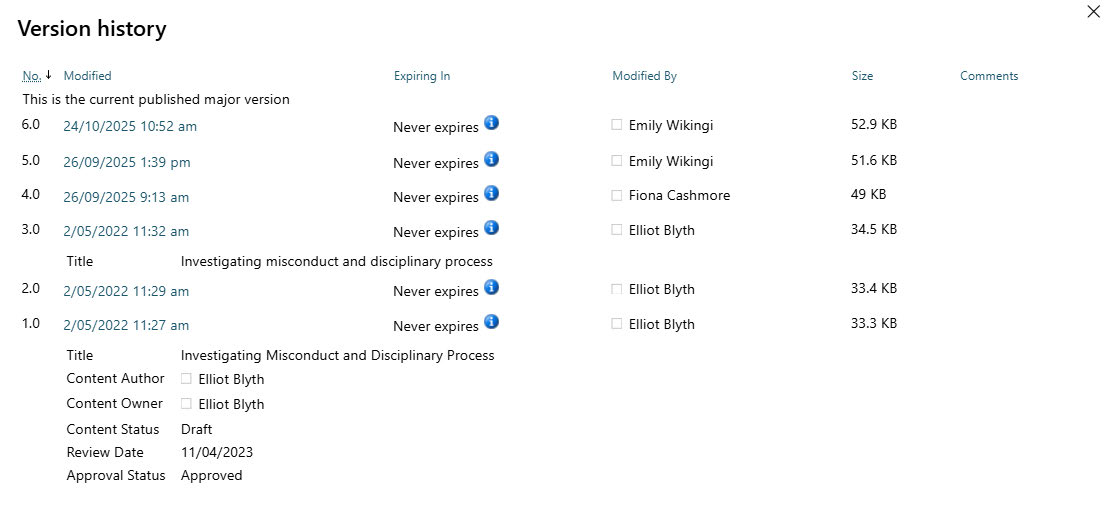
P&C to REVIEW – Version History
Version 6 is the current version (content above).
Versions 5 & 4 are substantively similar to the current version with small syntax changes.
Version 3 is also substantively similar to the current version (i.e. same process) but with a
greater number of syntax / vocabulary differences.
Versions 2 & 1 are out of scope of the request.
