Te Taiao (Intranet) Guidance – Raising a Complaint or Concern
Intranet link - https://ministryforenvironment.sharepoint.com/sites/Te-Taiao-
People/SitePages/Raising-a-complaint-or-concern.aspx?web=1
This page also has links to the following intranet pages:
• Investigating misconduct and disciplinary process
• Speaking up and the Protected Disclosures Act
Content of page:
Raising a complaint or concern
We take complaints seriously. This page has information about our processes and options
for handling complaints.
How to raise a concern
To raise a concern about potential or suspected wrongdoing you can talk to:
• a PSA representative
• your manager or another manager you trust
• a member of the People Services team
See Speaking up and the Protected Disclosures Act.
[Link to additional page on Intranet]
Your concern does not need to be in writing, however to raise a concern anonymously you
can send a letter to:
The GM People & Capability
Ministry for the Environment
PO Box 10362
Wellington 6143.
Employees can report concerns on someone else’s behalf, although we may not be able to
take action unless the person who has allegedly been the subject of the conduct tells us
that they want the matter pursued.
What happens next
We’ll:
• listen to your concerns and talk about what you’d like to happen
• check if there are any immediate safety, wellbeing needs or risks
• explain the process, your options and what support is available
Your choices
• You can choose to resolve the matter informally, make a formal complaint, or take
no further action.
• If you wish to remain anonymous, the Ministry will consider whether there is enough
evidence to proceed with an investigation.
• All parties involved are at all times entitled to a support person, or to seek legal
advice and/or representation if they wish to do so.
Every effort will be made to ensure your physical and psychological safety during this
process.
Once you have raised a concern, we will communicate clearly and regularly with you to
ensure that you understand what will happen once your concerns have been assessed.
Options for addressing concerns
We aim for early, informal resolution where possible. Possible options include:
• Speaking directly to the person involved (if comfortable)
• Supported intervention (with a manager or P&C team member)
• Facilitated discussion (with a neutral internal or external party)
• If informal options aren’t suitable, a formal complaint process is available.
In all cases, the aim is to stop the continuation of the behaviour causing concern and
ensure the wellbeing of the person who raised the concern.
Informal resolution options
Informal resolution is a useful way to address complaints or concerns. However, if a
complaint is serious, the Ministry may decide to formally investigate. Formal action won’t
begin until you’ve been informed and offered support options. The Ministry may elect to
appoint an independent external neutral party.
1. Speak up
You can raise the issue directly with the other person if you feel safe and confident doing
so. Let them know the behaviour is concerning and ask for it to stop.
It is a good idea to note what was said and/or letting your manager, their manager, or
People and Capability know. This can help if the behaviour continues.
2. Supported intervention
You can ask your manager, their manager, or People and Capability to help raise the issue
informally.
This won’t involve an investigation or disciplinary action.
The person you ask (mediator) will speak to the other person about your concerns. You
don’t have to be part of that meeting.
It’s recommended the mediator keeps a note of the discussion.
3. Facilitated discussion
Facilitation supports both parties to talk through concerns in a safe, guided way and agree
on future behaviour. Facilitated discussions can be between parties together or
separately.
It’s led by a neutral person—this could be a manager, People and Capability, or an external
facilitator.
Facilitation is informal: no findings are made and no disciplinary action is taken.
It focuses on resolving relationship issues and setting expectations for future interactions.
Outcomes and expectations are recorded. If someone doesn’t follow them, it may lead to
formal action later.
Participation is voluntary. All parties can bring a support person and withdraw at any time.
Facilitation is confidential and without prejudice—what’s said won’t be used against
anyone later.
Formal resolution - complaints
Making a formal complaint
To make a formal complaint, put it in writing and send it to your manager, their manager,
People and Capability, or a PSA representative. Include your name, details of the
behaviour, specific examples, dates, times, and any witnesses.
Your complaint and any information gathered during an investigation will be shared with
the person you’ve complained about. It may also be shared with witnesses if needed.
What happens next
Your complaint will be reviewed to decide next steps, based on how serious the issue is
and whether it can be investigated.
The Ministry will decide how the investigation will run—this includes whether terms of
reference are needed, who will investigate (internal or external), and how the process will
work.
There’s no assumption that the person complained about has done what’s alleged. They’ll
be given details of any allegation and a chance to respond, and all relevant information will
be considered before any conclusions are made.
If the complaint is upheld
If a formal complaint is substantiated, the Ministry will:
• Take steps to stop the behaviour and prevent it from happening again.
• Protect the complainant from any negative consequences.
• Let the complainant know what actions have been taken.
• Offer support through the Employee Assistance Programme (EAP) to both parties.
The Ministry may find the respondent has engaged in misconduct or serious misconduct. If
so, disciplinary action may be taken under the Disciplinary Process—this could include
dismissal.
The complainant will be told the outcome of the investigation, but not any disciplinary
action taken. Disciplinary processes are private and confidential.
Support will be offered to the complainant to support their wellbeing.
If the complaint is not upheld
If the complaint isn’t substantiated, the Ministry will:
• Let the respondent know the complaint wasn’t upheld and that no record will be
kept on their personal file
• Let the complainant know the complaint wasn’t upheld
• Protect both parties from any negative consequences
• Offer support through EAP to both parties
After any complaint—whether upheld or not—the Ministry will look at ways to support both
the complainant and the respondent.
Support
The Ministry wants to ensure that our people feel safe and supported during any
complaints process. We will take practicable steps to ensure the safety and wellbeing of
all parties involved in a complaint process.
At any stage, complainants and respondents can bring a support person to any meeting, or
to seek independent advice from their union, a lawyer, or other trusted person.
Managers should consult with their P&C Advisor/Business Partner before starting any
complaints process.
All employees have free and confidential access to EAP counselling support. Call 0800 327
669 to speak with someone.
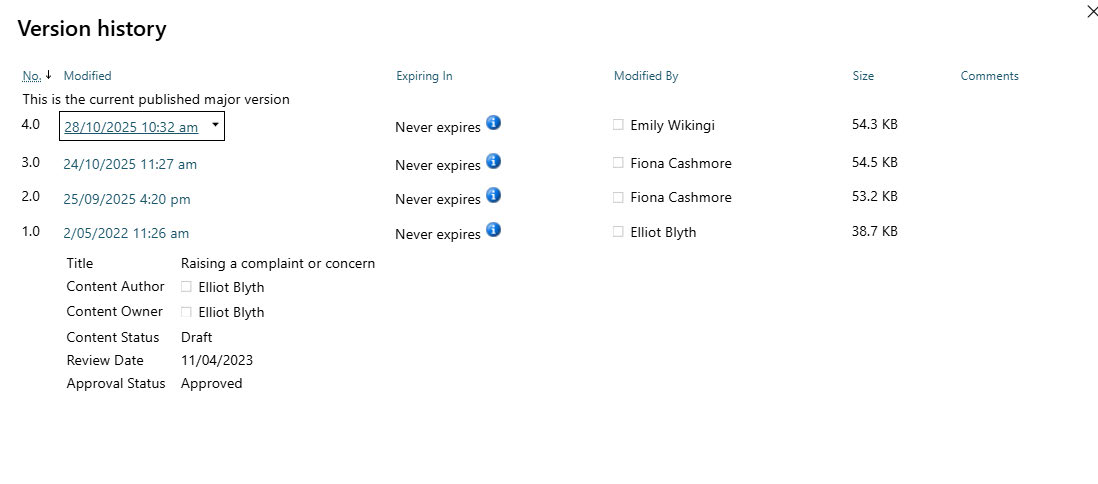
P&C TO REVIEW – Version History
Version 4 = current version (content above)
Version 3 = no substantive difference to current (small reordering of content for clearer
reading)
Version 2 and 1 = similar in spirit to current content but quite different language. Copy of
content below.
Raising a complaint or concern
You can safely raise and discuss any concern with:
• a member of the People and Capability team
• a PSA representative
• your manager
• your manager’s manager
• another manager or senior colleague you trust.
If you report concerns or a complaint, what follows is the ‘explore’ step which will:
• Allow you to consider how you would like your concern/complaint to be resolved.
• Allow MfE to assess whether there are any immediate actions that need to be taken to
ensure the safety of any person (for example, changing work areas, agreed working from
home arrangements or special leave).
• Ensure you feel heard and trust the process outlined for addressing these issues.
• Enable you to discuss the nature of the concern/complaint.
• Ensure you have information about support options available to you.
• Ensure you are aware of this Policy and the supporting guidance.
• Enable MfE to gain an understanding of the concern/complaint.
• Enable MfE to identify potential risks to the safety of any person.
• Discuss the options available to address the concern/complaint.
Next steps
Following that discussion, you should advise MfE whether you wish to deal with the matter
informally in the first instance, or whether you wish to make a formal complaint, or take no
further action.
All parties involved are at all times entitled to a support person, or to seek legal advice
and/or representation if they wish to do so.
Once you have raised a concern, we will communicate clearly and regularly with you to
ensure that you understand what will happen once your concerns have been assessed.
Anonymity
If the complainant wishes to remain anonymous, the Ministry will consider whether there is
enough evidence to proceed with an investigation.
If you wish to remain anonymous due to a fear of retribution or detriment, you should
discuss this with the person you raise the issue with. Every effort will be made to ensure
individual physical and psychological safety during this process.
Employees can report concerns on someone else’s behalf, although we may not be able to
take action unless the person who has allegedly been the subject of the conduct tells us
that they want the matter pursued.
Options for addressing concerns
Different options are available for addressing an issue or concern, these will be discussed
with you at the ‘Explore’ step. Some options may not be appropriate if the individuals
concerned are not employees. However, in all cases, the aim is to stop the continuation of
the behaviour causing concern and ensure the wellbeing of the person who raised the
concern.
Generally, lower-level and early intervention is the preferred resolution and is more likely
to result in a lasting solution.
Informal resolution options
The primary goal when addressing a complaint or concern informally is for the behaviour
that is being complained about to stop and not occur again.
Informal resolution may be an appropriate means of addressing a complaint or concern if
you feel able to deal with the problem yourself with support from the Ministry, or you can
choose another method of resolution that stops short of making a formal complaint.
The informal resolution pathways that are described below are in no particular order. You
could choose to use one or more of these options in any order that you choose.
Informal resolution options are valuable tools for addressing complaints or concerns.
However, there will be circumstances where an informal approach to resolving a
complaint or concern is not appropriate and the Ministry may decide that the complaint is
of such a serious nature that it should be formally investigated.
The Ministry will not initiate formal action without ensuring that you are informed and
provided with options for support.
1. Speak up
You can manage or address the issue yourself by approaching the other party privately to
talk about your concerns and make clear that you want the concerning behaviour to stop.
You should only take this option if you feel comfortable and able to do so.
If you do, it’s a good idea to make a note of what was said and/or to let your manager,
manager’s manager or a People and Capability team member know about the situation
beforehand. This may become important later on, particularly if you feel that the other
person’s behaviour is continuing.
2. Supported intervention
You can approach any of the people listed in the previous section and ask for their
assistance in mediating the issue or concern informally, in the same way as above.
“Informally” means that the matter won’t be investigated, and disciplinary action won’t be
taken.
The person (mediator) approached will meet with the other person to bring the concerns to
their attention. You can choose not to be involved in that meeting.
It is recommended that the mediator make a file note of the discussion.
3. Facilitated discussion
Facilitation is a process by which the complainant and the respondent are supported in a
safe and controlled manner to discuss the complainant’s concerns and reach an
agreement about future behaviour. Facilitated meetings are led by a neutral party who
assists and guides the complainant and respondent to discuss the behaviours that are
being complained about. Facilitated discussions can take place between employees
together or separately. Facilitation may be led by a manager, a People and Capability
representative or where appropriate, an external third party.
Facilitation may be appropriate where you do not feel comfortable raising your complaint
with the respondent on your own. It is an informal intervention because, again, no
conclusions will be reached about what has occurred and no disciplinary action can be
taken. The process is about acknowledging the existence of a relationship issue and
agreeing or implementing expectations about how the parties will interact with each other
in future. Records of discussions and any outcomes or expectations that are implemented
will, however, be recorded in writing. Failure by a party to comply with any expectations
that are put in place may subsequently become a disciplinary issue, or form part of a
formal complaint.
Participation in facilitation is voluntary. Every complainant and respondent who agrees to
engage in facilitation may have a support person attend with them.
Individuals who agree to engage in facilitation may choose to withdraw from it at any time.
If this happens the parties should discuss alternative types of resolution which are
available.
Facilitated meetings have the best chance of achieving resolution if the complainant and
respondent can engage in open and honest dialogue without being fearful that something
they might say will later be used against them. Facilitation is therefore held on a
confidential and without prejudice basis.
Formal resolution - complaints
Required information
When making a formal complaint, you need to put your complaint in writing to your
manager, manager’s manager, People and Capability team or a PSA representative,
identifying yourself and stating specific allegations/examples of alleged conduct, dates,
times and names of any potential witnesses.
That complaint, and all other relevant information gathered or provided in any investigation
process, will be provided to the person you have complained about, and may also be
provided to other witnesses if it is necessary to do so.
Process
The information you provide will be considered, and a decision on appropriate next steps
will be made (taking into account the seriousness of the alleged issue(s) of concern and
whether the complaint itself contains allegations that are capable of being investigated).
The nature of any investigation process (including whether terms of reference will be
necessary, whether an internal or external investigator will be appointed, who that person
will be and how the process will be carried out) will ultimately be determined by the
Ministry.
There is no presumption that the respondent has engaged in the specific allegation before
MfE has properly investigated the complaint, provided the respondent with an opportunity
to respond to the complaint, and reviewed any relevant information or material obtained
during the investigation.
If the complaint is substantiated and upheld
Where a formal complaint is substantiated, MfE will:
• Take reasonable steps to ensure that:
o the behaviour ceases immediately and is not repeated and
o the complainant is protected from any consequences of having made the complaint
• Advise the complainant of the steps that have been taken.
• Offer support via the Employee Assistance Program to both parties.
Where a complaint is substantiated, MfE may conclude that the respondent has engaged
in misconduct or serious misconduct. In such cases MfE may decide to impose
disciplinary action against the respondent, in accordance with its Disciplinary Process,
which may include one or more of a range of possible actions, up to and including the
respondent’s dismissal.
The complainant will be informed of the results of the investigation however, the
complainant will not be made aware of any disciplinary process or action that may be
undertaken or imposed in relation to the respondent. This is because any disciplinary
process is private and confidential to the person it concerns.
Support to the complainant will be provided to assist with their wellbeing.
If the complaint is not substantiated/upheld:
An investigation of a formal complaint may result in a finding that the complaint is not
substantiated. Where a formal complaint is not substantiated, the Ministry will:
• Advise the respondent that the complaint has not been substantiated and that no
material relating to the allegations against them will be held on their personal file.
• Advise the complainant that their complaint has not been substantiated.
• Ensure that both parties are protected from any consequences of the complaint.
• Offer support via the Employee Assistance Program to both parties.
Following the conclusion of any complaint or concern being raised, whether substantiated
or not, the Ministry will explore ways to support the complainant and the respondent.
Support and assistance
MfE wants to ensure that our people feel safe and supported during any complaints
process and therefore will take practicable steps to ensure the safety of all parties involved
in a complaint process.
Complainants and respondents are entitled at any stage to seek independent advice from
their union, a lawyer, or someone else they trust. We also welcome our people to bring a
support person with them to any meeting during the process.
Managers should consult with their P&C Advisor/Business Partner before commencing on
any process to discuss an approach. P&C Advisors/Business Partners are there to support
managers and guide them through the process.
All employees have free and confidential access to EAP counselling support. They can be
contacted on 0800 327 669.
