
1982
Act
Information
Official
the
under
Released
 134 Dixon Street, Wel ington
Purpose
134 Dixon Street, Wel ington
Purpose
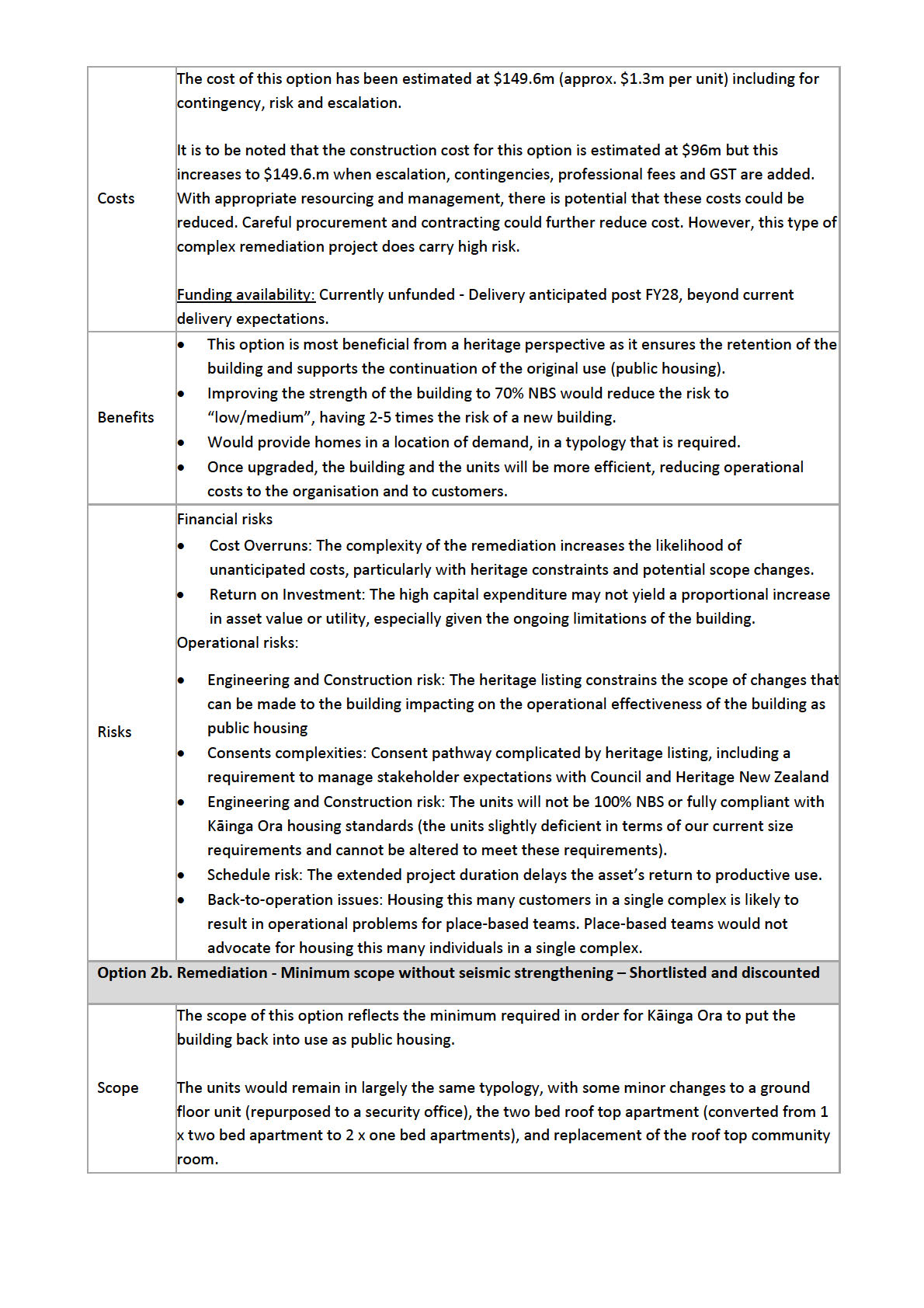
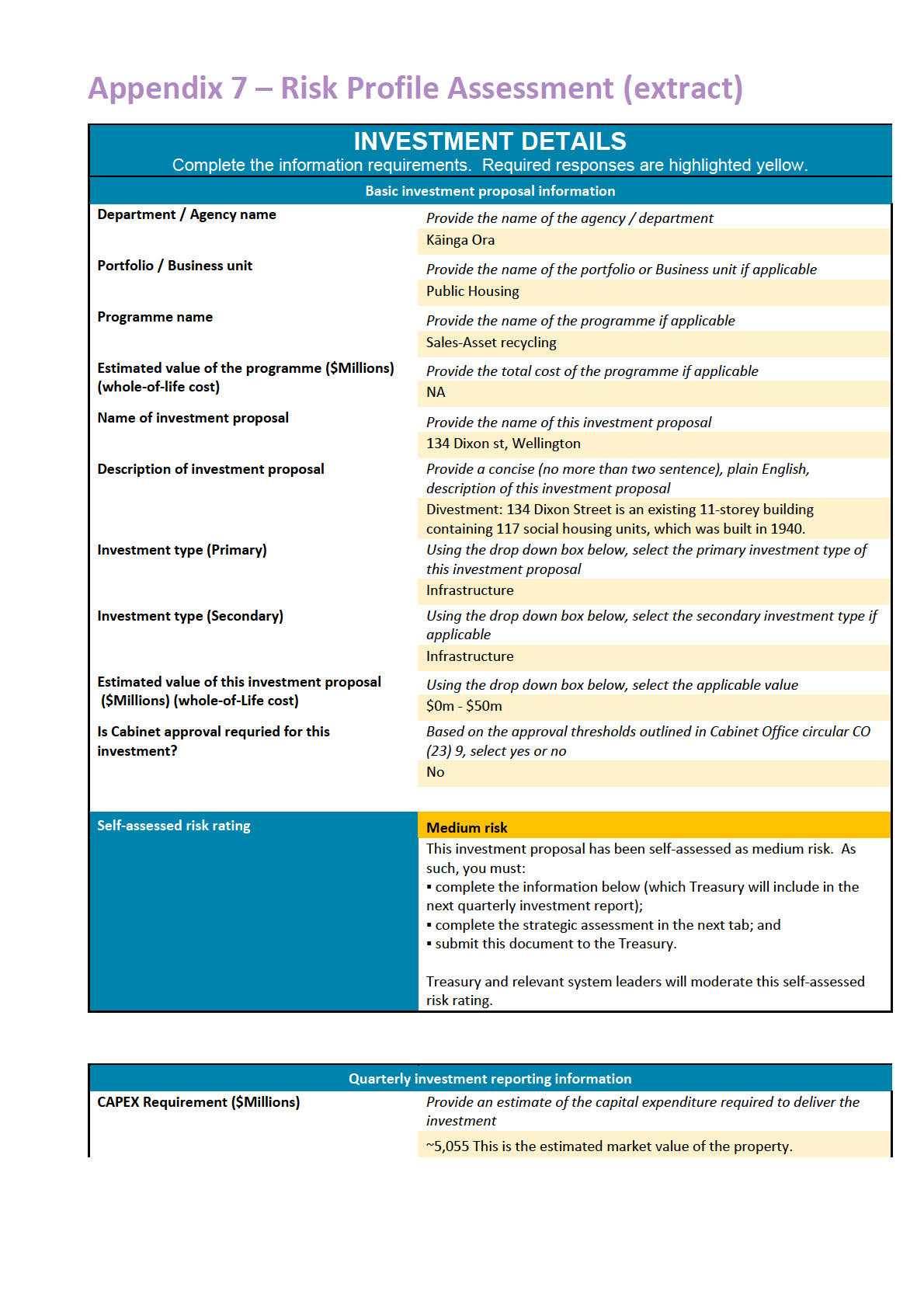
1. This paper seeks the Investment and Delivery Committee’s endorsement to the Board of the Business Case for the disposal of 134 Dixon Street, Te Aro,
Wellington.
Recommendations
1982
2. It is recommended that Investment and Delivery Committee (IDC):
Act
a)
Endorse to the Board the Business Case for the disposal of 134 Dixon Street
b)
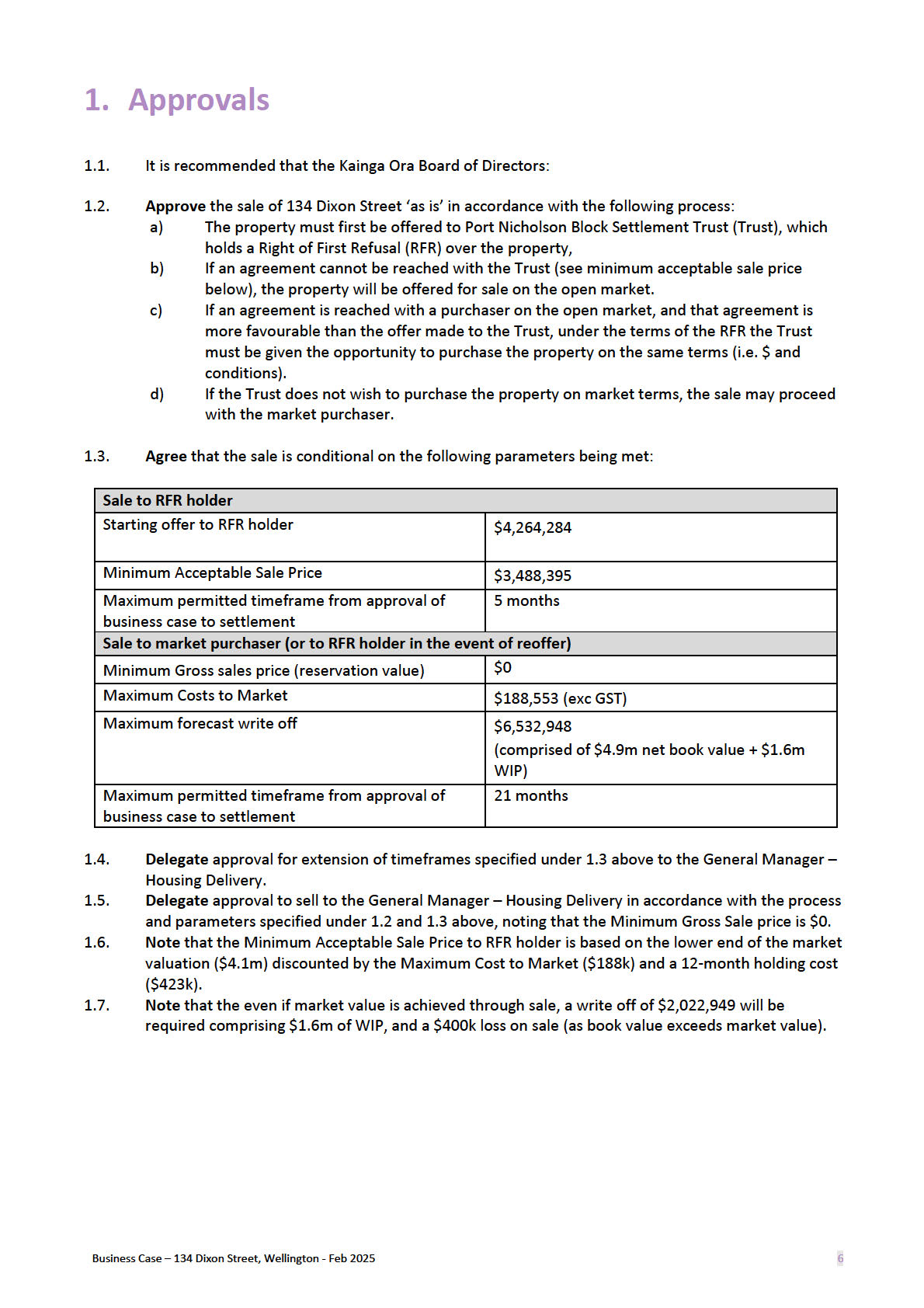
Note that (as legally required) the business case recommends sale to the Right of First Refusal holder, Port Nicholson Settlement Block Trust
(Trust), in the first instance with a Minimum Acceptable Sale Price of [$3,488,395], and if the minimum price cannot be agreed, then sale on the
open market (with no minimum price).
c)
Note that the business case recommends a Minimum Acceptable Sale Price to RFR holder bas
Information ed on the lower end of the market valuation ($4.1m)
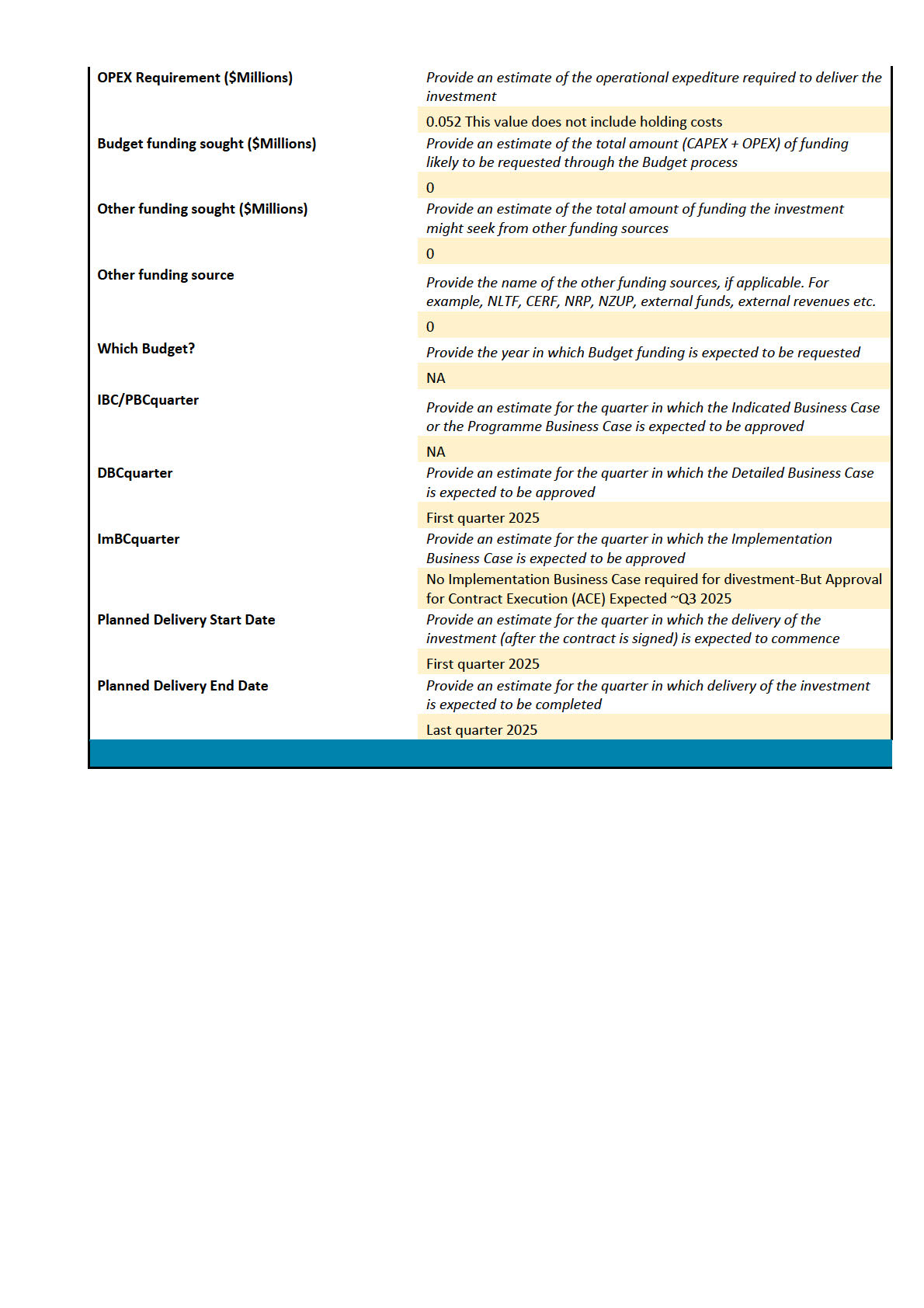
discounted by the Maximum Cost to Market ($188k) and a 12-month holding cost ($423k).
d)
Note that the business case recommends a Minimum Gross Sales Price (reservation value) of $0 and delegates the decision to
sel
to the General
Official
Manager – Housing Delivery.
e)
Note that even if market value is achieved through sale, a write-o
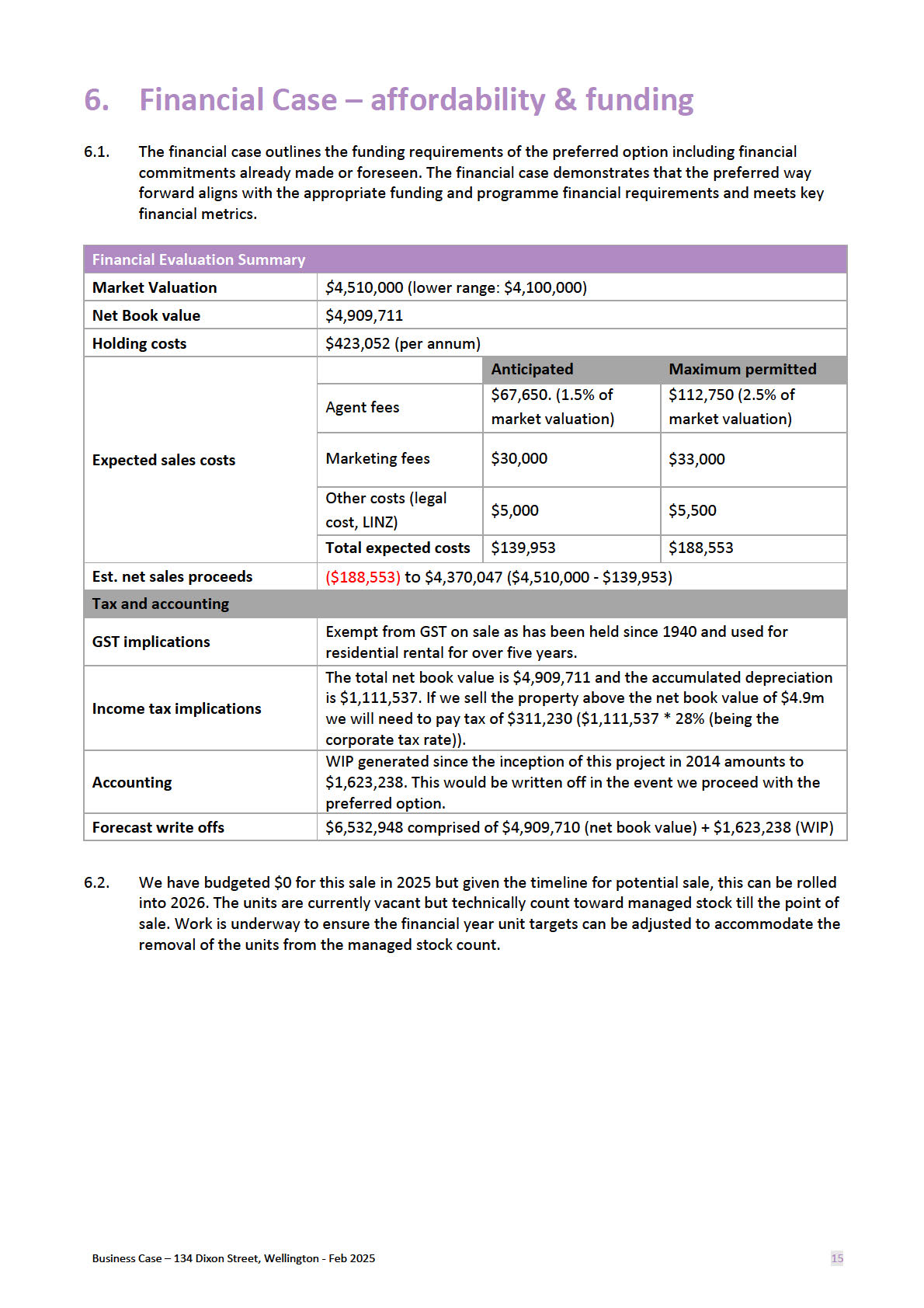
the ff of $2,022,949 wil be required comprising $1.6m of WIP and a $400k loss on
sale (as book value exceeds market value).
Background
under
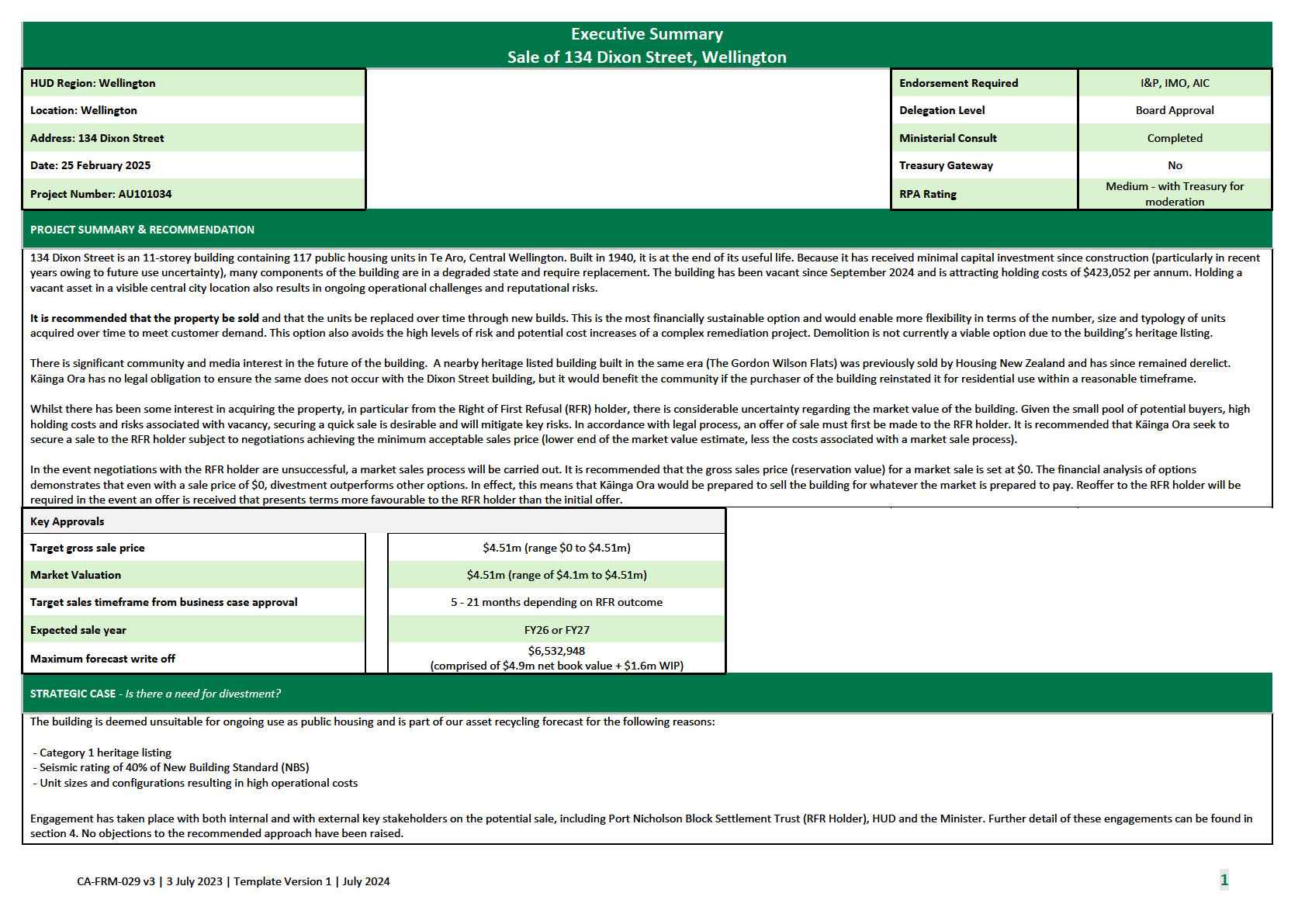
3. 134 Dixon Street is an 11-storey building containing 117 public housing units in Te Aro, Central Wel ington. Built in 1940, it is at the end of its useful
life. Many components of the building are in a degraded state and require replacement due to minimal capital investment since construction
(particularly in recent years owing to future use uncertainty). The building has been vacant since September 2024 and is attracting holding costs of
Released
$423,052 per annum. Holding a vacant asset in a visible central city location also results in ongoing operational challenges and reputational risks. The
building’s low seismic rating (40% NBS) and a heritage listing make demolition and redevelopment unachievable. There is significant community and
2
 134 Dixon Street, Wel ington
media interest in the future of the building. A nearby heritage-listed building built in the same era (The Gordon Wilson Flats) was previously sold by
Housing New Zealand and has since remained derelict. Further details are set out in the attached Business Case (Appendix A).
Discussion/Proposal
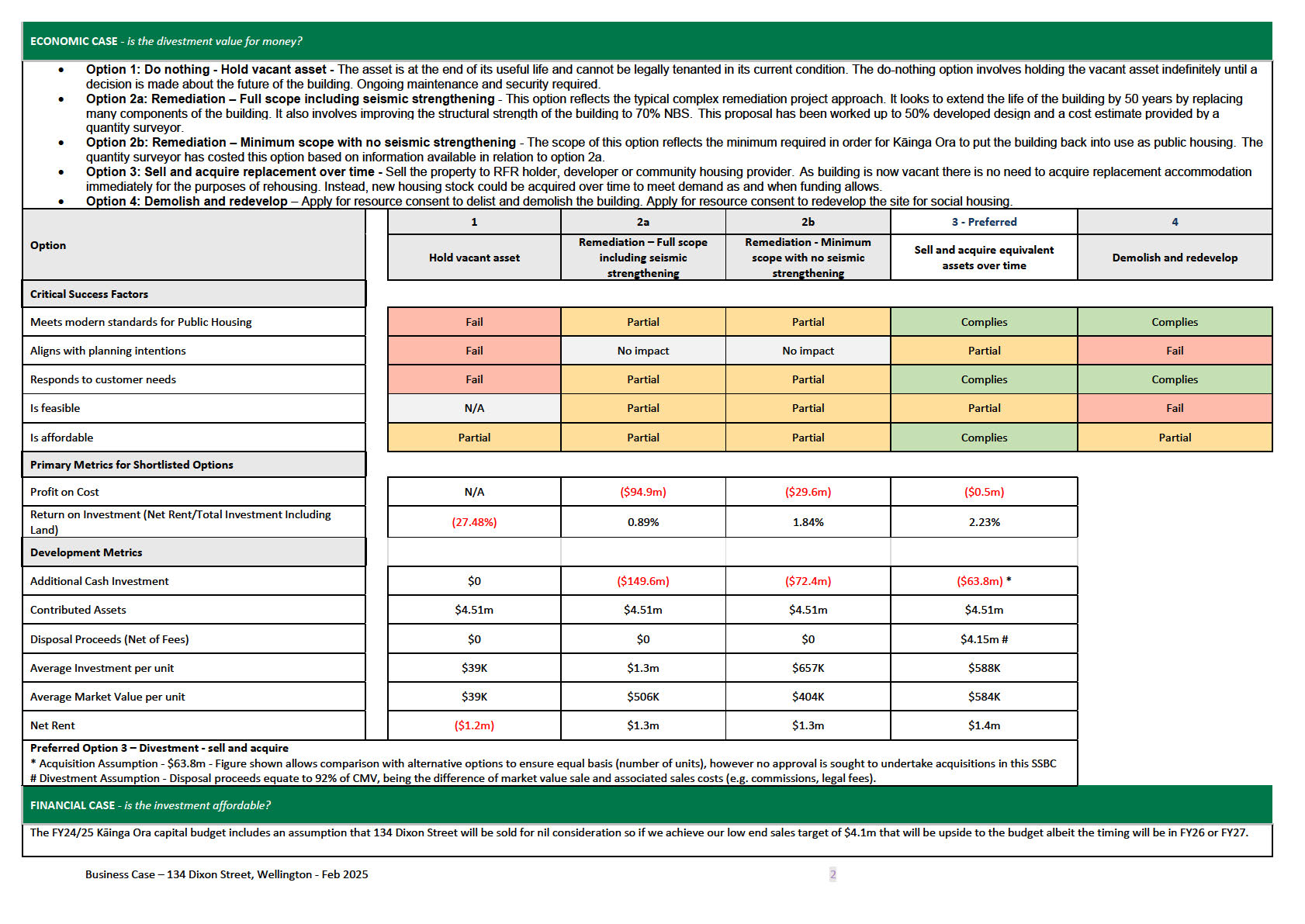
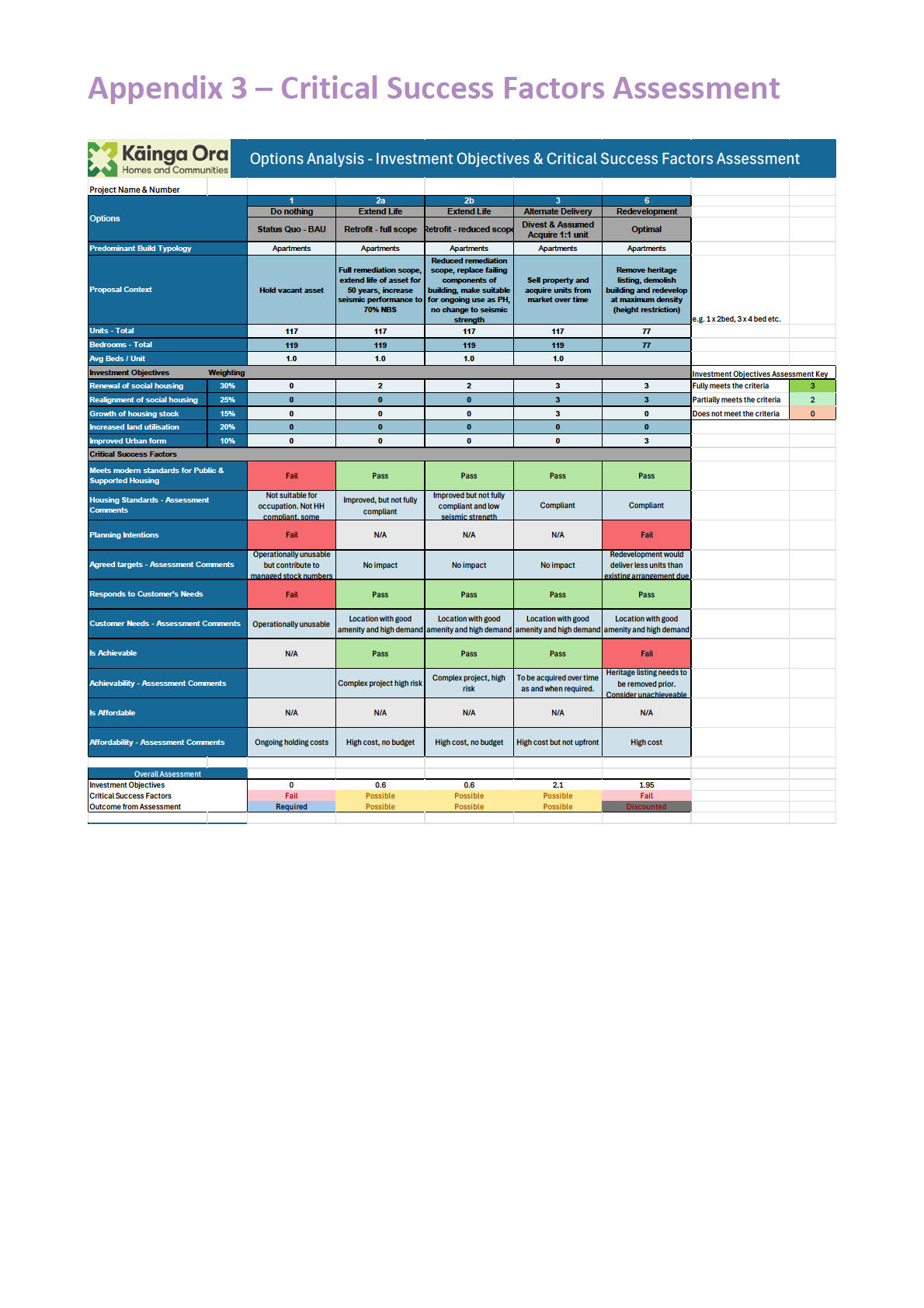
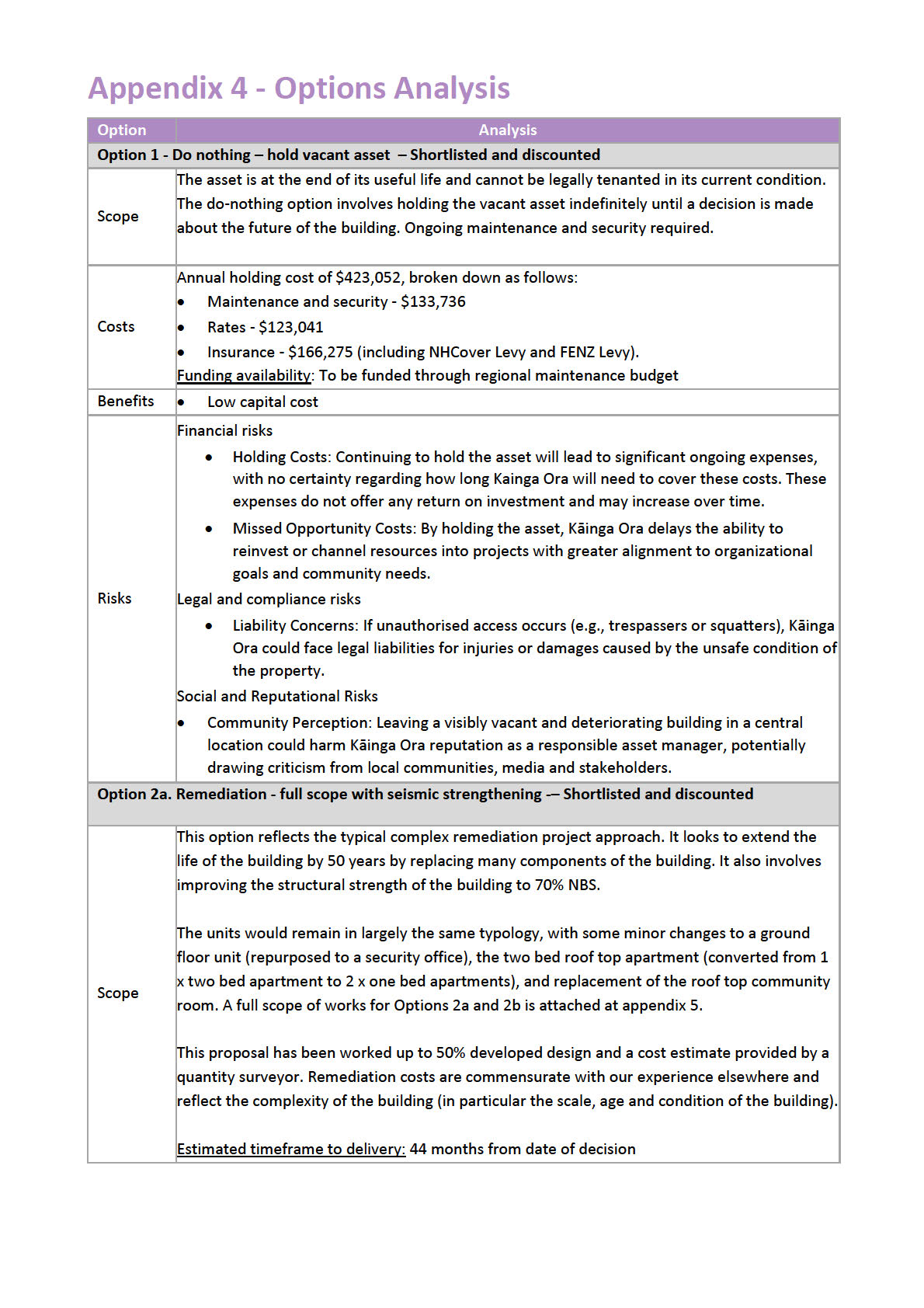
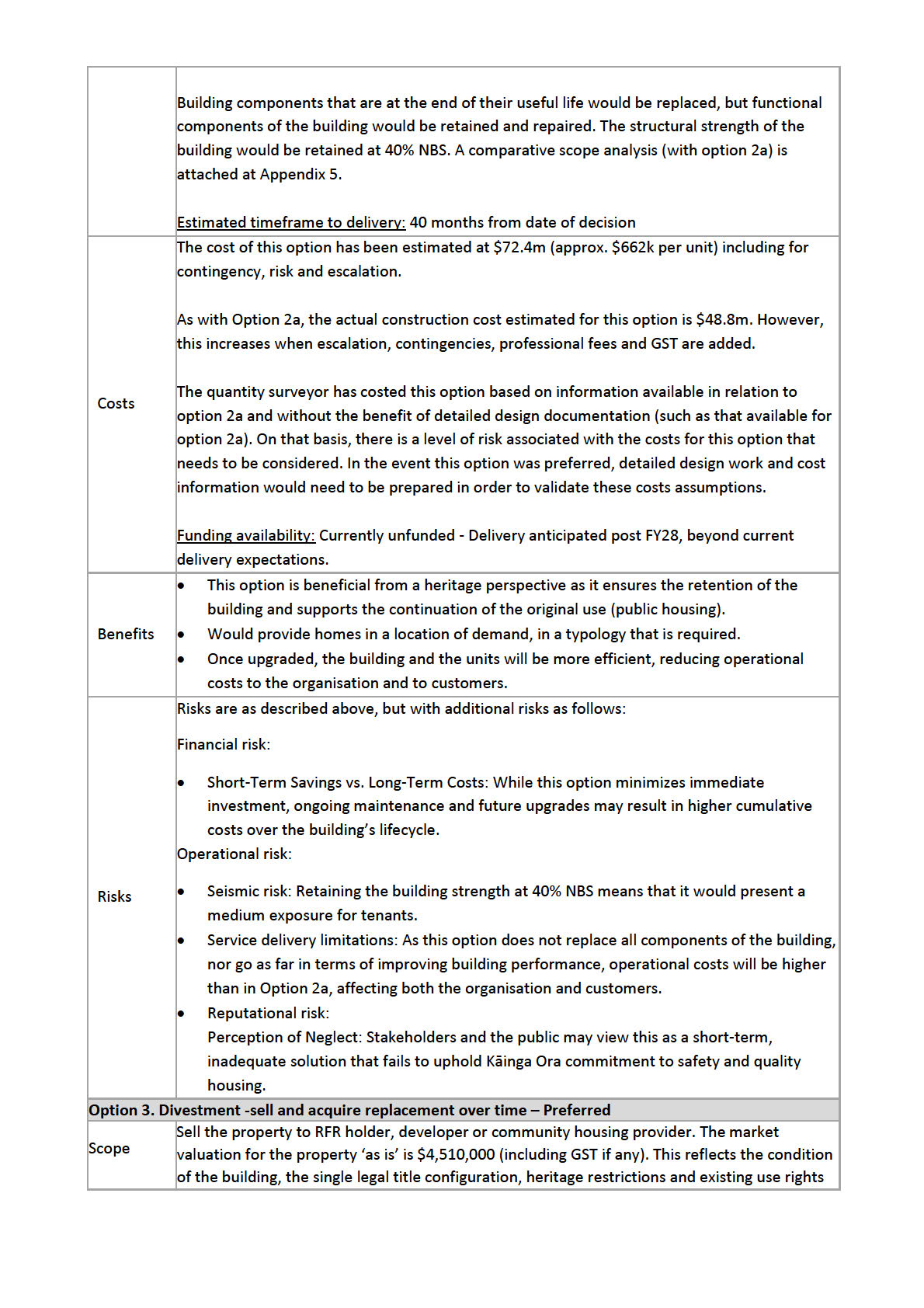
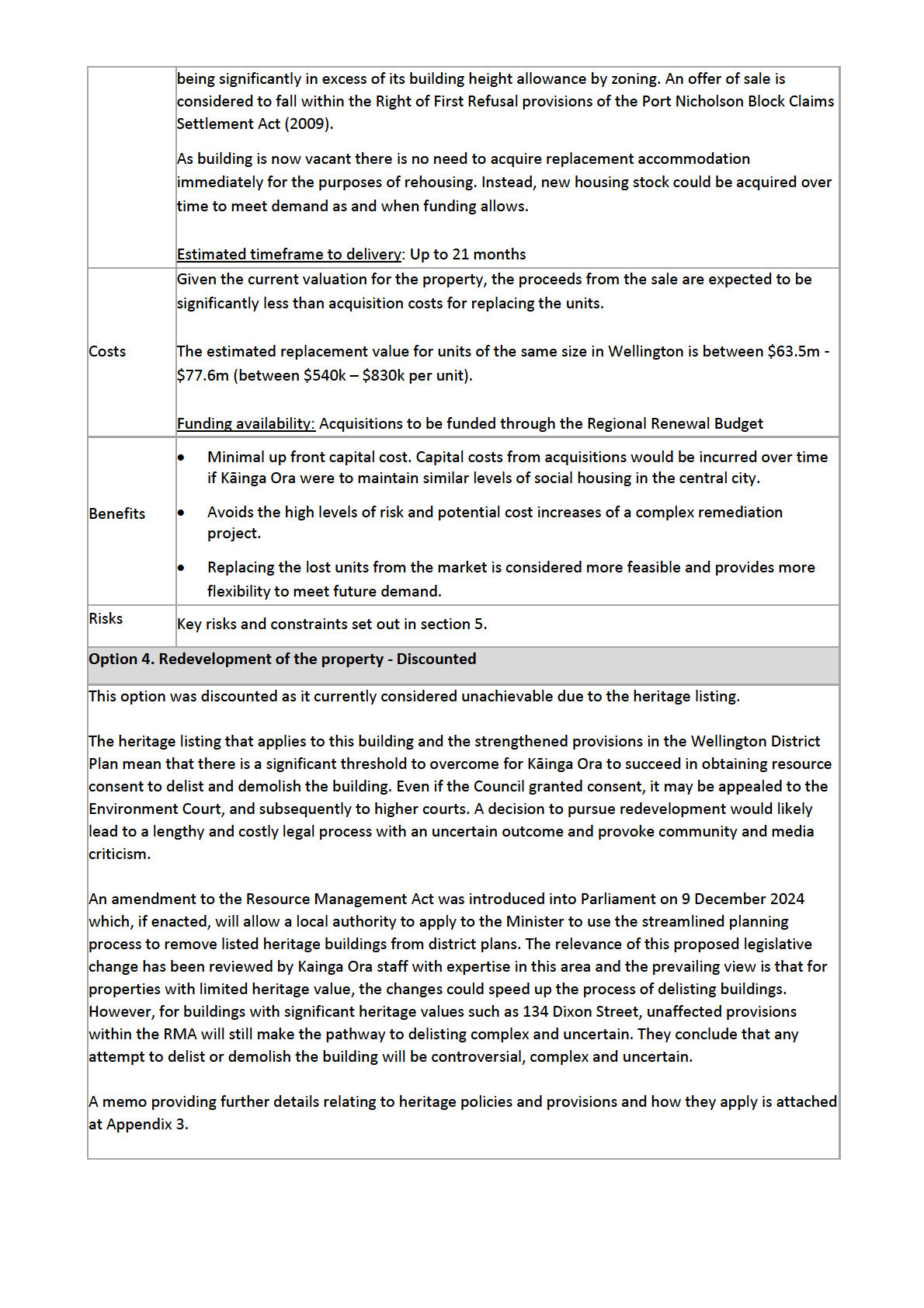
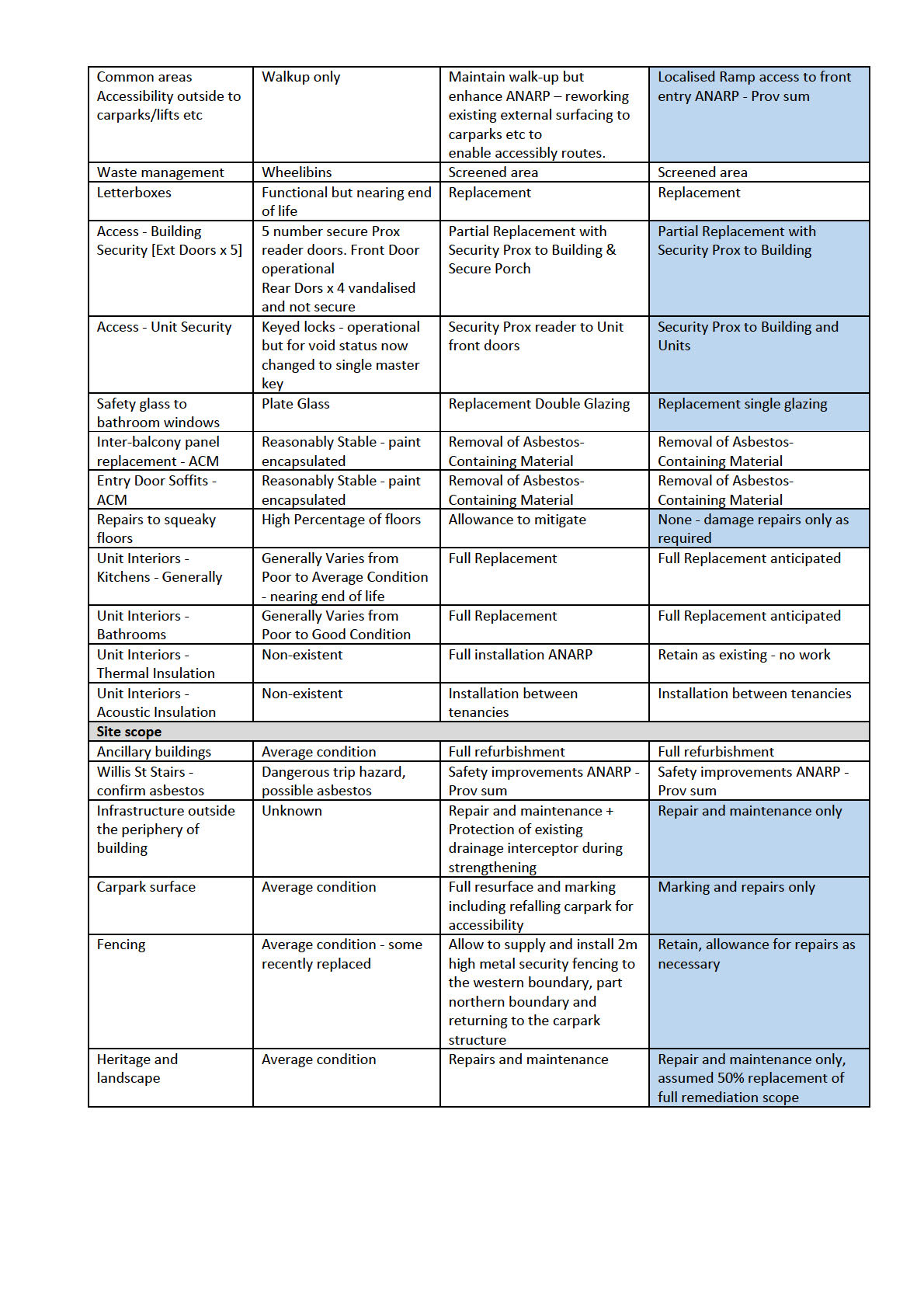
4. The business case tests the fol owing options for the property: Do nothing (status quo), full scope remediation (including seismic strengthening),
minimum remediation, divest (and acquire replacements over time), demolish and redevelop. These options are summarised in the Executive
1982
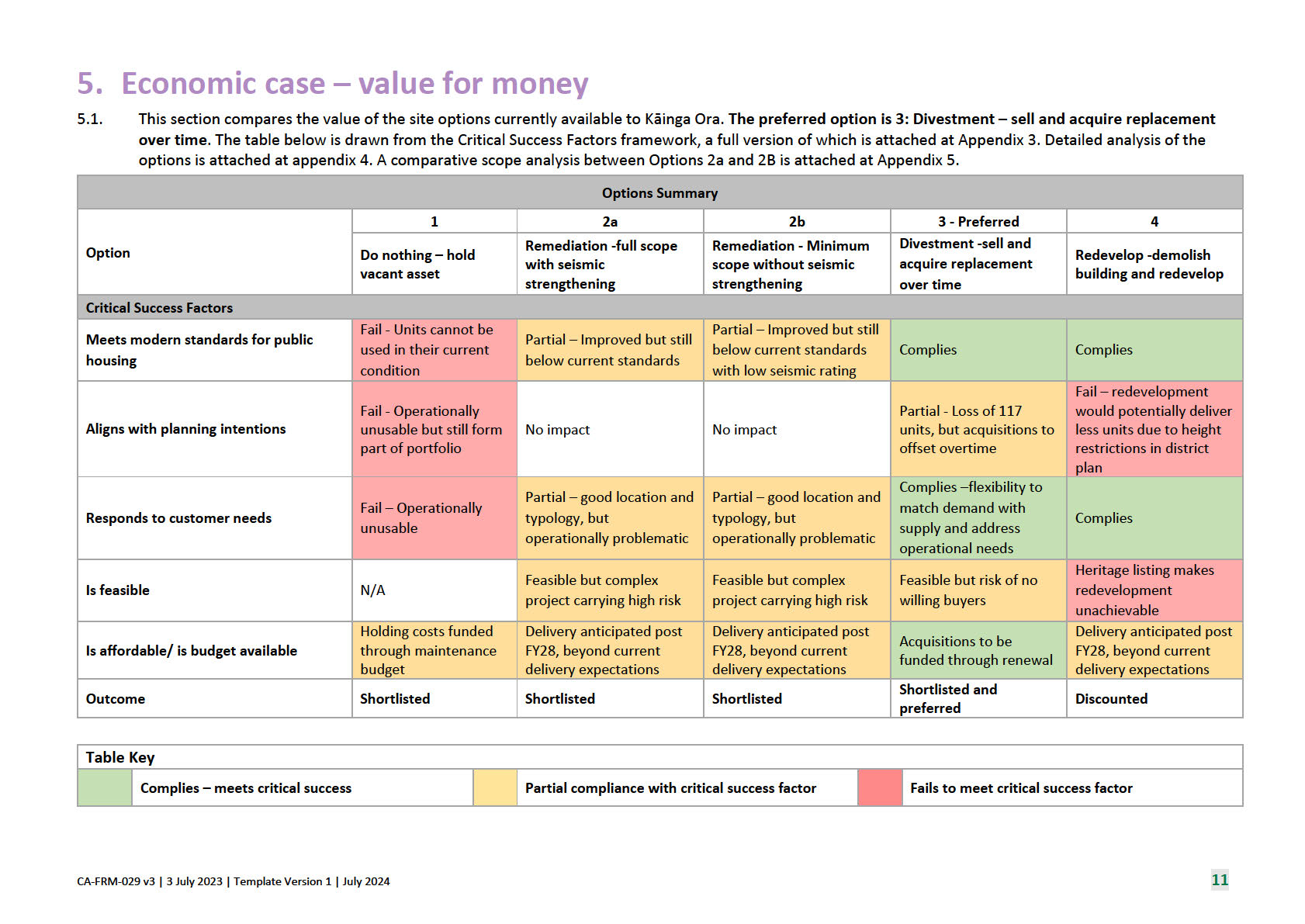
Summary to the business case. Divestment is the recommended option as it is the most financially sustainable and would enable more flexibility in
terms of the number, size and typology of units acquired over time to meet customer demand. This op
Act tion also avoids the high levels of risk and
potential cost increases of a complex remediation project.
5. In accordance with legal requirements, an offer of sale must first be made to the RFR holder. It is recommended that Kāinga Ora seek to secure a sale
to the RFR holder subject to negotiations achieving the minimum acceptable sales price of $3,488,395 (lower end of the market value estimate
[$4.1m], less holding costs and costs associated with a market sale process [$423k and $188k respectively]). If negotiations with the RFR holder are
Information
unsuccessful, a market sales process will be carried out. Re-offer to the RFR holder will be required in the event an offer is received from the market
that presents terms more favourable to the RFR holder than the initial offer.
6. Whilst there has been some interest in acquiring the property, in particular from the Right of First Refusal (RFR) holder, there is considerable
Official
uncertainty regarding the market value of the building. Given the smal pool of potential buyers, high holding costs and risks associated with vacancy,
securing a quick sale is desirable and will mitigate key risks.
the
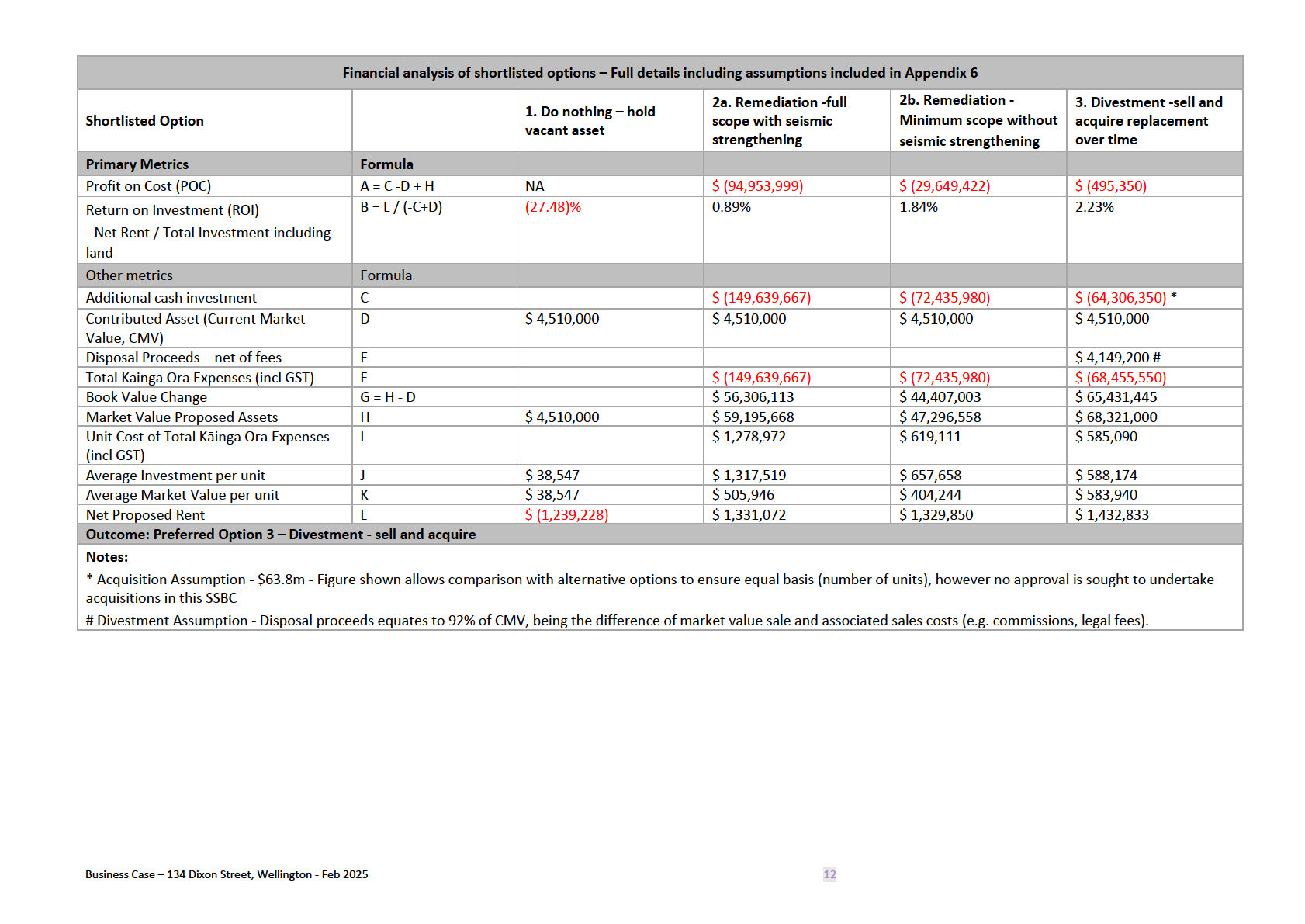
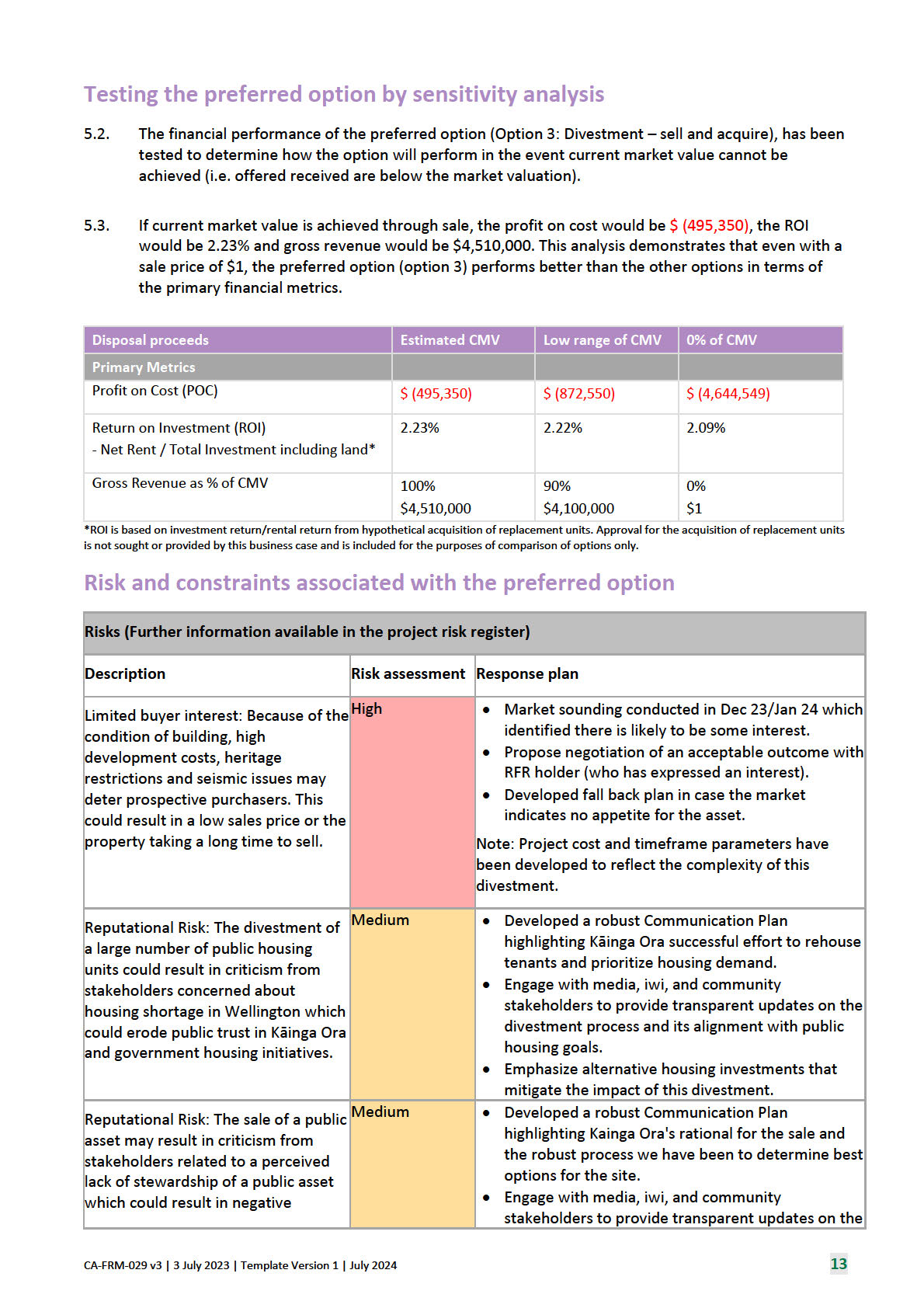
7. The financial analysis of options demonstrates that even with a sale price of $0, divestment of the property will outperform other options when
assessed against key financial parameters. For this reason, it is recommended that the gross sales price (reservation value) for a market sale is set at
under
$0. This will allow the General Manager – Housing Delivery the flexibility to accept an offer below the minimum acceptable sale price if this is
considered appropriate, taking into account the nature of any offers received and the key risks.
Next Steps
Released
8. Fol owing endorsement of the Business Case by IDC, the Business Case will be considered by the Kāinga Ora Board of Directors on 25 February 2025.
3

 134 Dixon Street, Wel ington
9. If the Business Case is approved by Board, the divestment process will commence immediately, in accordance with the process set out within the
Business Case (see page 16 of Appendix A).
Health and Safety
10. There are no health and safety issues associated with divesting the property. Although there is a security plan in place, continuing to hold a vacant
building in central Wel ington may lead to health and safety concerns.
1982
Attachments
Act
Attachment A - Business Case for the disposal of 134 Dixon Street, Wel ington
Attachment B - Appendices to the Business Case for the disposal of 134 Dixon Street, Wel ington.
Signature
Information
Official
the
Daniel Soughtton
Deputy Chief Executive - Central
under
Released
4
1982
Act
Information
Official
the
under
Released
1982
Act
Information
Official
the
under
Released

1982
Act
Information
Official
the
under
Released

1982
Act
Information
Official
the
under
Released
Contents
1. Approvals ..................................................................................................................................................... 6
2. Endorsements .............................................................................................................................................. 7
3. Background .................................................................................................................................................. 8
4. Strategic Case – the need for investment ................................................................................................... 8
5. Economic case – value for money ............................................................................................................. 11
7. Commercial Case – viability of the divestment ......................................................................................... 16
8. Management Case ..................................................................................................................................... 18
9. Document Control ..................................................................................................................................... 19
10. Appendices ................................................................................................................................................ 19
1982
Act
Information
Official
the
under
Released
Business Case – 134 Dixon Street, Wellington - Feb 2025
5
1982
Act
Information
Official
the
under
Released

1982
Act
Information
Official
the
under
Released
3. Background
3.1.
134 Dixon Street is an 11-storey building containing 117 public housing units in Te Aro, Central
Wellington. Built in 1940, it is at the end of its useful life. Because it has received minimal capital
investment since construction (particularly in recent years owing to future use uncertainty), many
components of the building are in a degraded state and require replacement.
3.2.
Due to the building’s seismic rating (see below), and consistent with Kāinga Ora Seismic Risk Policy at
the time, the building has been vacant since September 2024. A maintenance and security plan is in
place. The property is attracting holding costs of $423,052 per annum. Holding a vacant asset in a
visible central city location also results in ongoing operational challenges and reputational risks.
3.3.
Options for the future of the property are constrained by the condition of the building, as well as:
Low seismic rating: A Detailed Seismic Assessment (DSA) completed in October 2020
determined that the building has a strength of 40% New Building Standard (NBS). This means
it is classified as a Seismic Risk Grade C – being “medium” risk, having 5-10 times the risk of a
new building.
1982
Heritage listing: The building is one of three Kāinga Ora properties listed as a Category 1
Act
Historic Place on the New Zealand Heritage List/Rārangi Kōrero maintained by Heritage New
Zealand Pouhere Taonga (HNZPT). The building is also scheduled as a heritage building in the
Wellington City Council District Plan.
3.4.
Additional details relating to the property are set out in Appendix 1. An assessment of the heritage
constraints is attached at Appendix 2.
Information
4. Strategic Case – the need for investment
Project background
Official
the
4.1.
In 2017 the Housing New Zealand Investment Committee al ocated $9.7m from the Complex
Remediation Programme for the external remediation and internal refurbishment of the building.
4.2.
In 2020 a DSA determined that the building had a 40%NBS seismic rating and, in accordance with
under
organisational policy at the time, structural strengthening would be required.
4.3.
In 2021 the Renewals Programme Governance Board (Renewals PGB) rejected a proposal to renew
the building (requiring an investment of up to $96m). The Renewals PGB instructed the team to look
more closely at the other options (including redevelopment and divestment).
Released
4.4.
In 2022 internal approval was sought for a budget to carry out more detailed and invasive
investigations of the building to support the renewal option costings. The renewal option was
progressed through to 50% developed design and priced by a quantity surveyor in September 2023 at
$125m.
4.5.
Between December 2023 - January 2024, a confidential market sounding exercise was conducted with
three leading developers working in the Wellington property market to ascertain their appetite to
acquire the building as is. Based on this exercise, divestment was concluded to be a viable but high-
risk option.
4.6.
In October 2024, the Investment Delivery Committee (IDC) agreed that divestment was the preferred
option for 134 Dixon Street and instructed management to consult the Minister on that basis.
Business Case – 134 Dixon Street, Wellington - Feb 2025
8
4.7.
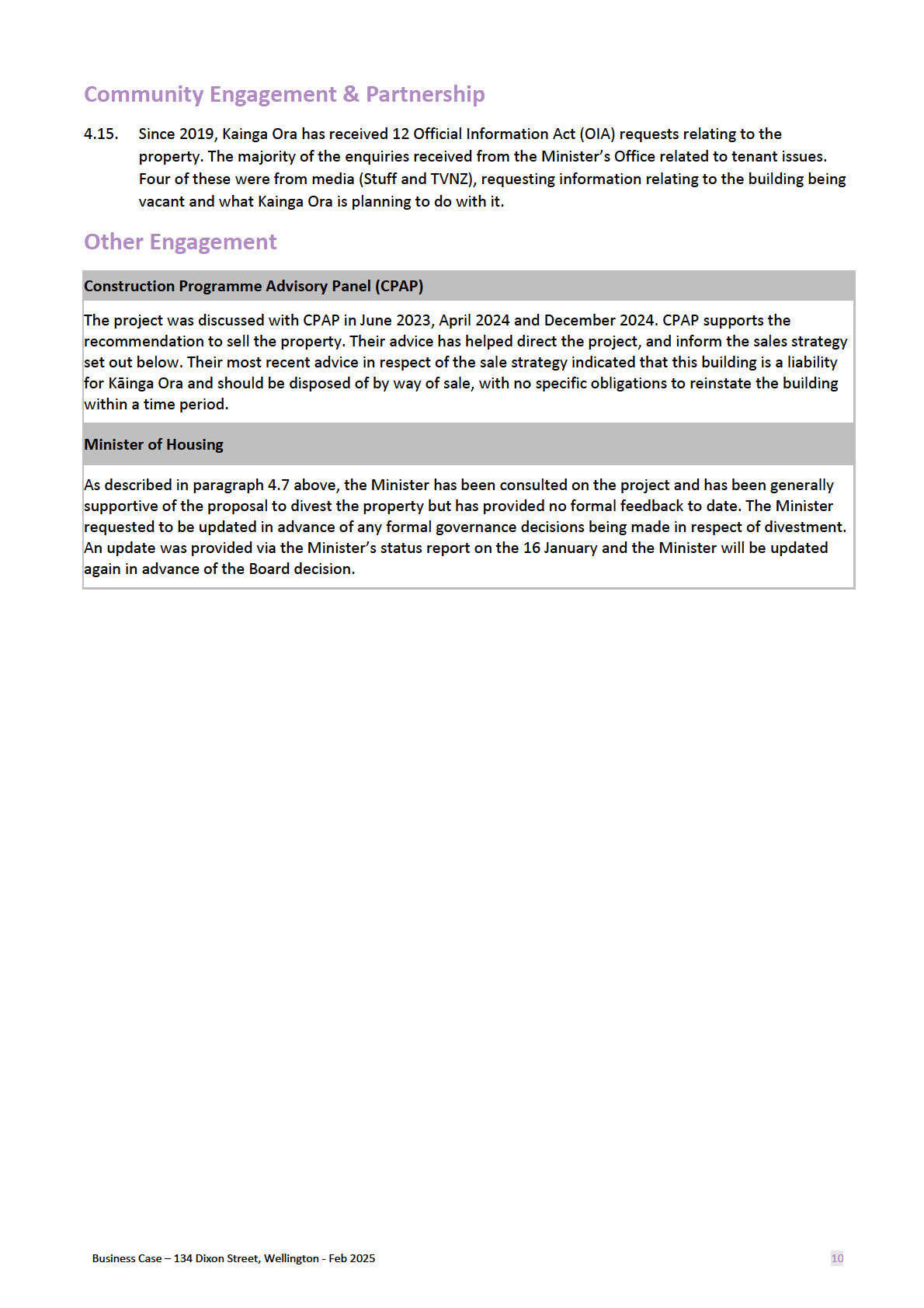
The Minister was generally supportive of divestment, including undertaking market soundings and
carrying out negotiations with the RFR holder, but requested the project be paused while he
considers action on the heritage listing issue. He requested an update be provided before any formal
decisions were made. On 16 January 2025 Kainga Ora advised the Minister that a business case for
divestment of the property was to be presented to the Board. A further update wil be provided
before 25 February to enable the Minister to provide an update on the heritage listing.
Strategic Context
4.8.
As of December 2024, there were 280 applicants on the Housing Register located in the Wel ington
City area (comprising Te Aro, Wellington Central, Mt Victoria and Mt Cook). The majority of the
demand (85% - 237 applicants) is for one bed units. In the last 2 years (December 2022 to December
2024), Kāinga Ora have supplied 197 new public housing places in the city. During this time, the
housing register changed from 336 to 280 (-56). 154 additional housing units are proposed to be
delivered in the Wellington Region before the end of FY25, but none of these wil be in the Wellington
City area.
4.9.
The existing units within Dixon Street are of a bedroom size that would contribute to m
1982 eeting
demand and therefore technically meet the definition of ‘core asset’ in the Asset Management
Act
Strategy (2022) and ought to be retained.
4.10. However, housing 117 customers in a single complex that was not originally designed with modern
safety and security features incurs additional operational complexity and cost. More recently the site
has experienced frequent instances of antisocial behavior and was not always considered a safe place
for our tenants, some of whom were vulnerable, with high and complex support needs. These
challenges were further exacerbated by the disruptive behavior of visito
Information rs, attracted by the central
city location of the complex. In response to these issues, CCTV cameras were installed, and varying
levels of security monitoring and presence has been provided at this site over the last 7 years.
Tenancy management resourcing levels were also adjusted to meet the higher-than-average needs
Official
during this period.
the
Māori Needs and Aspirations
4.11. The Trustees of the Port Nicholson B
under lock Settlement Trust (PNBST) hold mana whenua status in
Wel ington and represent the interests of Taranaki Whānui ki Te Upoko o Te Ika (often referred to as
Taranaki Whānui), who are the descendants of iwi living in the Wellington Harbour area at the time of
the signing of the Treaty of Waitangi who originated from the Taranaki region of the North Island.
These iwis include (Te Āti Awa, Ngāti Tama, Taranaki Tūturu, Ngāti Ruanui, and other iwi from the
Released
Taranaki area (for example, Ngāti Mutunga)). The collective name given to these iwi is Taranaki
Whānui ki Te Upoko o Te Ika (often referred to as Taranaki Whānui).
4.12. PNBST’s Right of First Refusal (RFR) is set out in sub-part 2 of Part 3 of the PNBST Claims Settlement
Act 2009 and prevents disposal to third parties unless an offer is first made to the RFR Holder.
Exceptions to the RFR includes disposals to the Crown or Crown bodies and disposals where the
Minister of Housing consider that the disposal will achieve, or assist in achieving, the Crown’s social
objectives in relation to housing or services related to housing.
4.13. PNBST have been kept up to date on project progress and are aware of the options being considered
for the future of the property, including divestment.
4.14. PNBST has expressed an interest in the project and property, and an offer for acquiring the property
has been presented to Kāinga Ora for consideration. Further details are set out in the Commercial
Case.
Business Case – 134 Dixon Street, Wellington - Feb 2025
9
1982
Act
Information
Official
the
under
Released
1982
Act
Information
Official
the
under
Released
1982
Act
Information
Official
the
under
Released
1982
Act
Information
Official
the
under
Released

1982
Act
Information
Official
the
under
Released
1982
Act
Information
Official
the
under
Released
7. Commercial Case – viability of the divestment
7.1. A market valuation (obtained in January 2025) estimated the ‘as is’ value of the property at $4,510,000,
with a lower range of $4,100,000. The range reflects the uncertainty related to the condition of the
existing building, the heritage designation, cost and risk involved in reinstatement and prevailing
market conditions.
7.2. PNBST made a pre-emptive offer to purchase the property in October 2024; however, the offer price
was $1. We understand that, in making the offer, PNBST’s intention was to enter into a leasehold
arrangement with a local developer, with PNBST retaining a ground rent of $100k per annum. Whilst
this offer is not considered to reflect value for money (based on the market valuation) it does indicate a
level of interest.
7.3. Taking into account the market uncertainties and constraints and in order to mitigate against the risks
of Kainga Ora retaining the vacant property, it is recommended that a reduced sales price be agreed at
which the property may be sold to the RFR holder. The proposed starting offer for negot
1982 iations with
the RFR holder is the ‘as is’ market valuation, less costs associated with the sale ($4.51m - $139k -
$106k 3 month holding cost). However, it is recommended that Kāinga Ora acce
Act pt any counteroffers
above the proposed minimum acceptable sales price of $3,488,395. The minimum acceptable sales
price reflects the lower end of the market valuation, less costs associated with sale ($4.1m - $188k -
$423k anticipated 12 month holding cost). Maximum timeframes for negotiation and settlement
periods are specified as conditions of sale to secure the benefits associated with accepting reduced
sales price and wil be communicated to the RFR holder at the outset.
Information
7.4. In the event negotiations with the RFR holder are unsuccessful, a market sales process will commence.
It is recommended that the gross sales price (reservation value) for a market sale is set at $0. In effect,
this means that Kāinga Ora would be prepared to sell the building for whatever the market is prepared
Official
to pay. Reoffer to the RFR holder will be required in the event an offer is received that presents terms
more favourable to the RFR holder than the
the initial offer.
7.5. It is also recommended that the property be sold with no further requirements on the sale to ensure
the best value can be achieved for the site. Consideration has been given to whether Kainga Ora should
under
look to impose timeframes or encumbrances that require a purchaser to maintain the building during
any period of vacancy or renovate the property before re-tenanting. However, it is recommended that
this is not required. While the property remains in Kainga Ora ownership, Kainga Ora is required to
proactively manage the building and act as a steward for the heritage values the building possesses.
However, once sold, the pro
Released perty is no longer a Kainga Ora responsibility.
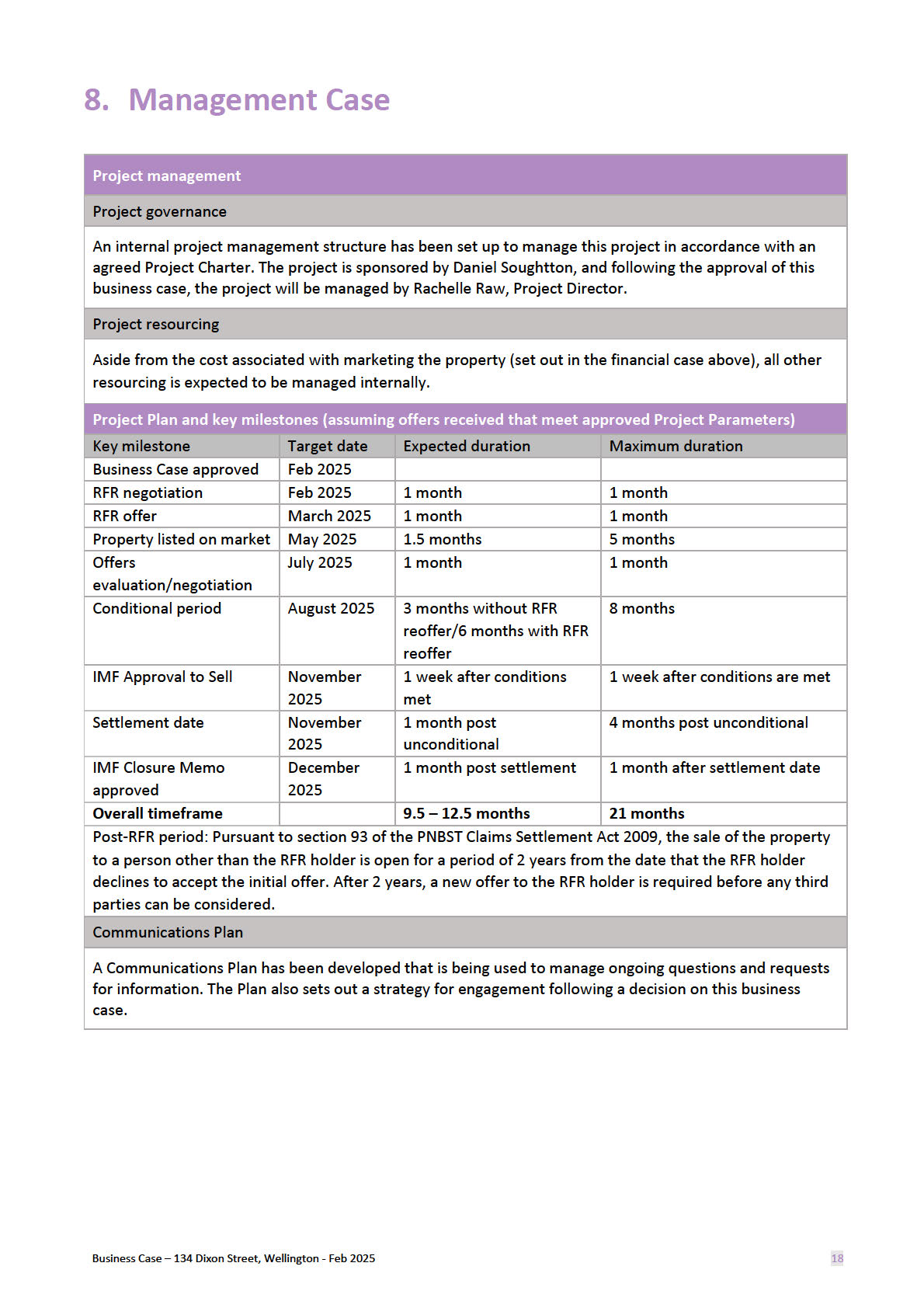
7.6. The proposed process for divesting this property is as follows:
a)
Negotiation with RFR holder will commence at the starting offer to RFR holder of $4,264,284
b)
Within one month of commencement of negotiations, property will be formally offered to
the RFR holder. The value of the offer will be:
i. At the same value as the counteroffer received from the RFR Holder, in the event that
the counteroffer is above the minimum acceptable sales price; or
ii. At the starting offer to RFR holder ($4,264,284), in the event that the counteroffer is
below the minimum acceptable sales price, or no counteroffer is received.
c)
The expiry date for the formal offer to the RFR holder will be one month.
d)
If the Right of First Refusal offer is not accepted, or expires, an open market sale process will
be undertaken.
e)
The property will be offered on the market for an initial six-week campaign.
Business Case – 134 Dixon Street, Wellington - Feb 2025
16
f)
If offers are not received at the conclusion of the six-week campaign, the property will be
listed for price by negotiation for a further three months.
g)
If an open market offer is received that provides terms no more favourable (to the purchaser)
than the last offer made to the RFR holder, then an Approval to Sell memo will be prepared
once due diligence is complete and a Sale and Purchase Agreement is ready to go
unconditional.1
h)
If no offers are received, or if offers fall outside the approved parameters specified in
paragraph 1.3 above, further options wil be presented to the Board for consideration.
1982
Act
Information
Official
the
under
Released
1 If an offer is recieved that is more favourable to the purchaser then those terms must first be offered to the RFR
holder.
Business Case – 134 Dixon Street, Wellington - Feb 2025
17
1982
Act
Information
Official
the
under
Released
1982
Act
Information
Official
the
under
Released

1982
Act
Information
Official
the
under
Released

1982
Act
Information
Official
the
under
Released
Appendix 2 - Memo – Assessing Heritage Constraints
at 134 Dixon Street – Operational Policy Team, Dec
2024
1982
Act
Information
Official
the
under
Released

Memo
To:
9(2)(a)
, Principal Advisor – Development Strategy
From:
9(2)(a)
– Manager, Operational Policy
Date:
15 January 2025
Subject:
Assessing Heritage Constraints at 134 Dixon Street
Purpose
1.
The purpose of this memo is to establish a common understanding of the heritage constraints
involved at 134 Dixon Street. This note has been prepared by the Operational Policy team, with
input from the Development Planning Team.
Heritage Status
1982
2.
134 Dixon Street has significant heritage values. It is one of the most significant present or former
state housing buildings in New Zealand. It is one of the most significant heritag
Act e assets owned by
Kāinga Ora.
3.
134 Dixon Street is one of three1 Kāinga Ora properties listed as a Category 1 Historic Place on the
New Zealand Heritage List/Rārangi Kōrero maintained by Heritage New Zealand Pouhere Taonga
(HNZPT)2. The other properties are the First State House and the Berhampore State Flats, both in
Information
Wellington.
4.
Inclusion on the New Zealand Heritage List does not provide automatic protection of the building
Official
and its heritage values. This is generally achieved through a territorial authority (local council)
scheduling heritage features in their district plan, which is prepared under the Resource
the
Management Act 1991 (RMA).
5.
District plans include an objective, policy and rule framework, to manage and assess potential
under
adverse effects on scheduled heritage features. Inclusion on a heritage schedule protects a feature
from the effects of a redevelopment proposal (and generally requires a resource consent
application), but can not require the feature to be maintained, so there can still be effects
associated with neglect or lack of maintenance.
Released
6.
134 Dixon Street is a scheduled heritage building in both the Operative and Proposed Wel ington
City District Plan. This means that the building is subject to rules to avoid, remedy or mitigate
effects of activities that may lead to the degradation or loss of its heritage values. In both Plans, the
scheduling is limited to external matters and does not include the building’s internal features. Note:
This does not mean internal features should not be protected if feasible, it simply means a resource
1 For completeness, it should be noted that the Heritage Inventory identified an additional three properties that are
within a Category 1 heritage protection zone, but they are captured as they are located near a site of heritage
significance and the Kāinga Ora owned buildings appear not to be significant in themselves.
2 https://www.heritage.org.nz/the-list/details/7395
consent is not required to modify internal features.
7.
Any proposal to demolish, relocate, or modify the exterior of the building (other than maintenance
or repairs) requires a resource consent. The proposal would then be assessed against criteria set
out in the Proposed Plan (and possibly the old Operative Plan).
8.
An application for resource consent would be assessed as a discretionary activity under the
Proposed Plan. It appears the Proposed Plan rules for 134 Dixon Street should now be treated as
operative (as per section 86F of the RMA) as they are not subject to chal enge and the period for
submissions has passed. In the Proposed Plan the site is in the High Density Residential Zone, with a
22m max height and 50% site coverage, so possibly any new building could not be significantly
bigger than the existing building.
9.
The Proposed Wellington City District Plan increases the threshold to justify demolition of listed
heritage buildings. Two key changes are: new, specific information requirements that put a greater
onus on applicants to demonstrate remediation or divestment are not financially viable; and the
1982
requirement for public notification of any resource consent application.
Act
Obligations for Kāinga Ora 10.
Kāinga Ora must operate in a manner consistent with the operating principles set out under the
Kāinga Ora—Homes and Communities Act 2019. One of these principles is to operate in a manner
which recognises environmental, cultural, and heritage values. This means that Kāinga Ora is
required to consider these values when it makes asset management decisions, but does not
Information
necessarily require heritage values to override other considerations.
11.
In November 2022, Cabinet approved a new “Policy for Government Management of Cultural
Heritage Places” (MCH Policy), to take effect from 1 F
Official ebruary 2023.3 The new policy applies to all
state sector organisations including Crown entities, such as Kāinga Ora. It requires agencies to
the
adhere to best practices when handling cultural heritage assets, and to act responsibly in both the
management and potential sales of these assets.4
under
12.
The MCH Policy expects government agencies to integrate heritage considerations into property
management, comply with related laws, and seek expert advice.
13.
Agencies should col aborate with iwi and hapū, document their heritage management, and report
on policy compliance. The Policy notes how it is important to understand and maintain an inventory
Released
of heritage places, support protection efforts, plan for long-term conservation, and promote
cultural heritage values.
3 https://mch.govt.nz/policy-government-management-cultural-heritage-places-2022
4 The MCH Policy was approved by Cabinet. Although it is not legal y binding on Kāinga Ora (unless it is issued as a
policy direction under the Crown Entities Act 2004) it is clearly intended to apply to Crown entities. The new
Government could review the MCH Policy, especial y considering the potential financial impact it has on agencies
managing large property portfolios, but at present it remains the Government policy for government agencies
managing heritage sites.
14.
The MCH Policy requires consideration of relevant heritage knowledge and values, emphasising
continuous oversight and conservation of heritage sites. Heritage protection during property
disposals, and the consideration of heritage in acquisitions and leases are also emphasised.
15.
The MCH Policy does not require protection of heritage at any cost. The guidance states that the
continued use of an asset for its original purpose may be important to maintain its heritage
significance (e.g. public housing) and wherever possible, an agency should endeavour to maintain
that use. However, where that is not practical, an agency should seek an adaptive reuse compatible
with the asset’s heritage significance.
Draft Kāinga Ora Heritage Policy and heritage work
16.
Unlike most government agencies with significant property assets, Kāinga Ora does not have a
current Heritage Policy. There is a 2007 Housing New Zealand Policy for the Long-Term
Management of Heritage Assets, but it is not in active use. In March 2024, the Chief Executive’s
Leadership Group (CELG) and the Finance Risk and Assurance Board Subcommittee (FRAC)
endorsed a new draft Kāinga Ora Heritage Policy (draft Heritage Policy).
1982
17.
The draft Heritage Policy incorporates many parts of the MCH Policy, but only requires Kāinga Ora
Act
to understand our heritage assets and consider their treatment in our asset management systems
and development plans. The draft Heritage Policy does not require Kāinga Ora to maintain, repair,
or redevelop our assets in a way that is unaffordable.
18.
With an impending change in Board membership, it was decided not to present the draft Heritage
Information
Policy to the Board for final approval and the draft Heritage Policy is on hold.
19.
134 Dixon Street would almost certainly be defined as one of our top heritage places. Under the
draft Heritage Policy decisions on its future would ne
Official ed to be made carefully, but it does not mean
disposal is ruled out and any decision should be affordable.
the
Heritage Value of 134 Dixon Street
20.
134 Dixon Street was constructed as part of the First Labour Government’s state housing
under
programme and symbolises a significant period of social development in New Zealand. The building
represented a radical departure from the single dwelling state-housing model that preceded it. It
would go on to become an archetype of multi-unit housing in New Zealand and influenced several
other buildings constructed between 1940 and 1960, such as the Gordon Wilson Flats in Wel ington
and the Upper Greys Avenue building in Auckland.
Released
21.
The building is one of the first examples of the functionalist style that characterised the modernist
movement in New Zealand architecture and is the country’s first example of a slab apartment
block. For many years, 134 Dixon Street were also a defining feature of the Wellington City
townscape.
22.
Both the Operative and Proposed Wellington City District Plans encourage the preparation of
conservation plans for listed heritage items. In November 2020, WSP (formerly Opus Consultants)
finalised a conservation management plan commissioned by Kāinga Ora for 134 Dixon Street.
23.
WSP fol owed established international precedent and New Zealand guidelines to assess the
significance of the building. Their assessment was made across a range of factors on a four-step
scale from exceptional to little/no significance. WSP concluded that 134 Dixon Street has
exceptional significance at a national level, both as a cultural symbol and architectural icon, and at
a local level as a key feature of the Wellington townscape.
24.
134 Dixon Street stands out as one of the few heritage properties in our ownership with significant
heritage values and associated significant RMA restrictions. The key heritage constraints for 134
Dixon Street are the RMA – the Wellington City Proposed and Operative District Plans. Even if
Kāinga Ora can justify demolishing the property or doing some substantial modification to it, RMA
approval will still be required.
Gordon Wilson Flats
25.
The nearby Gordon Wilson Flats are a useful case study to consider. Like 134 Dixon Street, the
Gordon Wilson Flats are also considered an influential example of modernist architecture and an
icon of the early state housing programme (although a later example than 134 Dixon Street and
1982
possibly less significant). In 2014, Housing New Zealand sold the Flats to Victoria University, who
planned to demolish the buildings. At the time, the building was listed under the Wel ington City
Act
District Plan Heritage Schedule, but not on the New Zealand Heritage List.
26.
In 2016, the University successfully applied to remove the Flats from the Wellington City District
Plan Heritage Schedule, allowing for redevelopment to occur. However, an architecture advocacy
group went on to appeal the Council decision to the Environment Court. The appeal was upheld (by
Information
majority decision), and the Court reinstated the heritage scheduling, which has effectively halted
the redevelopment proposal. In 2021 the Gordon Wilson Flats were listed as a Category 1 Historic
Place on the New Zealand Heritage List.
Official
27.
The Wellington City Council included the Gordon Wilson Flats as a listed heritage building in the
the
Proposed Wellington District Plan in July 2022. However, in March 2024, Wellington City Council
rejected an Independent Hearing Panel recommendation and voted to remove the Flats from the
Heritage Schedule. The Minister then rejected the Council recommendation in May 2024 and the
under
Gordon Wilson Flats are still on the Heritage Schedule.
28.
The Gordon Wilson Flats have now been vacant for over 10 years and are in a state of visible
disrepair. One lesson from the Gordon Wilson Flats is, if Kāinga Ora is to divest itself of 134 Dixon
Street, then letting the building sit vacant and fall into disrepair should be avoided. This risk could
Released
be reduced by sel ing to an experienced and reputable developer. With any disposal there is some
risk that a new owner could allow the building to fall into disrepair. Potentially Kāinga Ora could
look at imposing a heritage covenant, although enforcement may be difficult and heritage
protection is not our core business.
RMA Reform
29.
The Hon Chris Bishop, Minister of Housing and Minister of RMA Reform, has said that the
Government intends to “simplify heritage management” as part of Phase 2 of RMA Reform.5 The
Resource Management (Consenting and Other System Changes) Amendment Bil was introduced
5 https://www.beehive.govt.nz/release/rma-reform-phase-two-priorities-and-plan
into Parliament on 9 December 2024. Clause 20 allows a local authority to apply to the Minister to
use the streamlined planning process to remove listed heritage buildings and structures in district
plans. The Bil is expected to be enacted in mid-2025.
30.
Although the Bil should make the process faster to get a decision on “delisting” if the Council and
Minister agree to use the new process, the Bill makes no change to the protection of historic
heritage being a “matter of national importance” (section 6) that RMA decision makers (Councils,
Ministers, Courts etc) must “recognise and provide for”. As such, if a council wants to delist a site
that it included in its district plan that does not have much historic heritage value, the change could
(if enacted) speed up the process. But if the site actually has significant heritage values it may well
still be quite difficult to reach a conclusion that it should be delisted.
31.
Additionally, if enacted, a council would have to choose to use it. In March 2024 the Wellington City
Council asked the Minister to delist a number of buildings, including the Gordon Wilson Flats.
However, they did not apply to delist the Dixon Street Flats. It is also worth noting that the Dixon
Street Flats have been listed in the Wellington District Plan far longer than the Gordon Wilson Flats
1982
and arguably have more heritage value. Dixon Street Flats may also be more economically viable to
restore than the Gordon Wilson Flats as they are not earthquake prone and appear to be in better
Act
physical state.
32.
Any attempt to delist and/or demolish 134 Dixon Street is likely to be controversial, even if the
delisting process is streamlined.
Information
33.
It is likely the Phase 3 RMA reforms will make more significant changes to reduce (or even remove)
the status of heritage as a consideration in the legislation that replaces the RMA. The RMA
replacement legislation is not expected to be enacted until 2026 and even if heritage is removed
from the RMA, demolition of a heritage building (und
Official er other statutes) may still be controversial.
the
Conclusion
34.
134 Dixon Street has significant heritage values. This is recognised by the building’s Category 1
status on the New Zealand Heritage
under List and its inclusion on the Wellington City District Plan
Heritage Schedule. An independent conservation management plan commissioned by Kāinga Ora
also concluded that the building is of exceptional social and architectural significance.
35.
The heritage significance of 134 Dixon Street, and the strengthened provisions in the Proposed
Released
Wellington City District Plan mean that there is a significant threshold to overcome for Kāinga Ora
to succeed in obtaining resource consent to demolish the building. Even if the Council granted
consent, it may be appealed to the Environment Court, and subsequently to higher Courts. A
decision to pursue demolition could lead to a lengthy and costly legal process with an uncertain
outcome. It may also be inconsistent with the MCH Policy and the operating principles in the Kāinga
Ora Act unless it is clearly not affordable for Kāinga Ora to retain the building and there is no
suitable alternative owner. If demolition approval was obtained it appears the residential zoning of
the site may not allow a larger building than the existing building to be constructed without
resource consent being sought.
36.
If it is not affordable for Kāinga Ora to retain 134 Dixon Street, divestment is a feasible alternative.
It is possible that the heritage of the building may add value and make redevelopment of the
property for private housing (e.g. as top end apartments) more economic for a developer than for
Kāinga Ora who can only obtain income based on a modest fit out.
1982
Act
Information
Official
the
under
Released
1982
Act
Information
Official
the
under
Released
1982
Act
Information
Official
the
under
Released
1982
Act
Information
Official
the
under
Released
1982
Act
Information
Official
the
under
Released
1982
Act
Information
Official
the
under
Released
Given redevelopment is currently unachievable, limited work has been undertaken to understand the
redevelopment potential of the site. However, it is noted that the existing building has a height of
approximately 33 metres and sits above the al owable height control limit of 22 metres set out in the
District Plan. As part of the valuation process, the valuer approached Wellington City Council to understand
whether any existing use rights would be transferable to a new development, and the Council responded as
follows: “It would be debatable if existing use rights would continue to apply, as it is arguably the heritage
building status itself that defines/determines the maximum height of the building”. They further stated
“that existing use rights are dependent on matching intensity of use, bulk and location, so any departure of
these in a rebuild situation would have the potential to impact upon existing use rights”.
In the event delisting and demolition was considered possible, further work would need to be undertaken
to determine whether redevelopment, potential y at a reduced density, would be feasible.
1982
Act
Information
Official
the
under
Released

1982
Act
Information
Official
the
under
Released

1982
Act
Information
Official
the
under
Released
1982
Act
Information
Official
the
under
Released
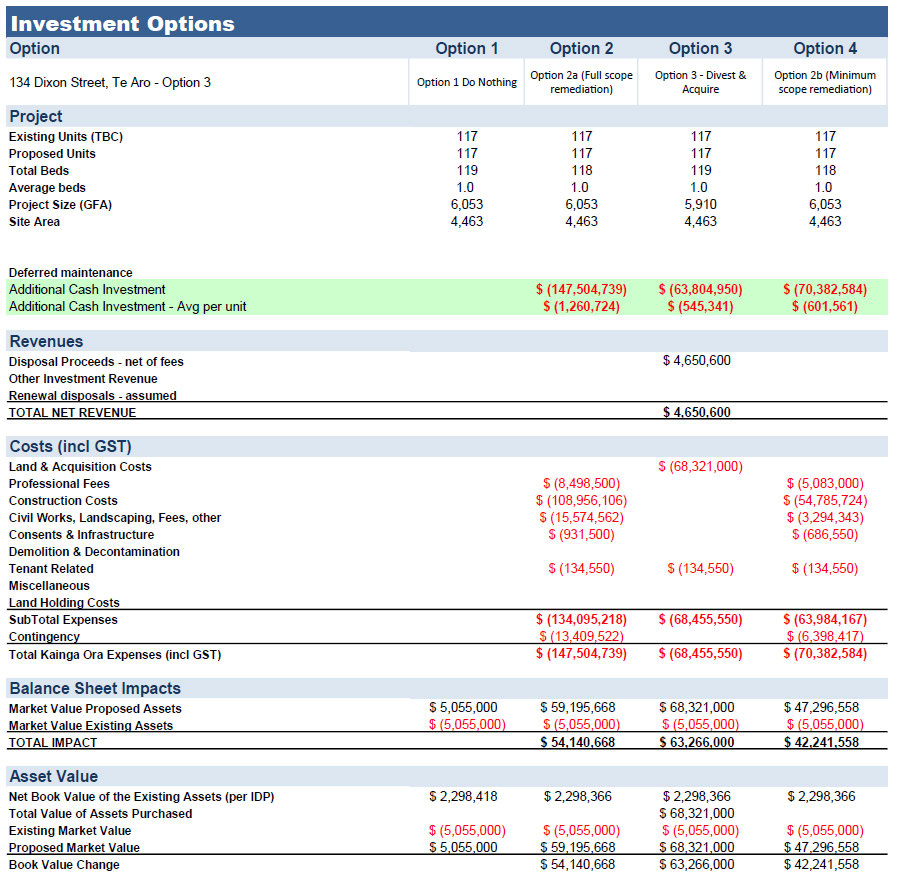
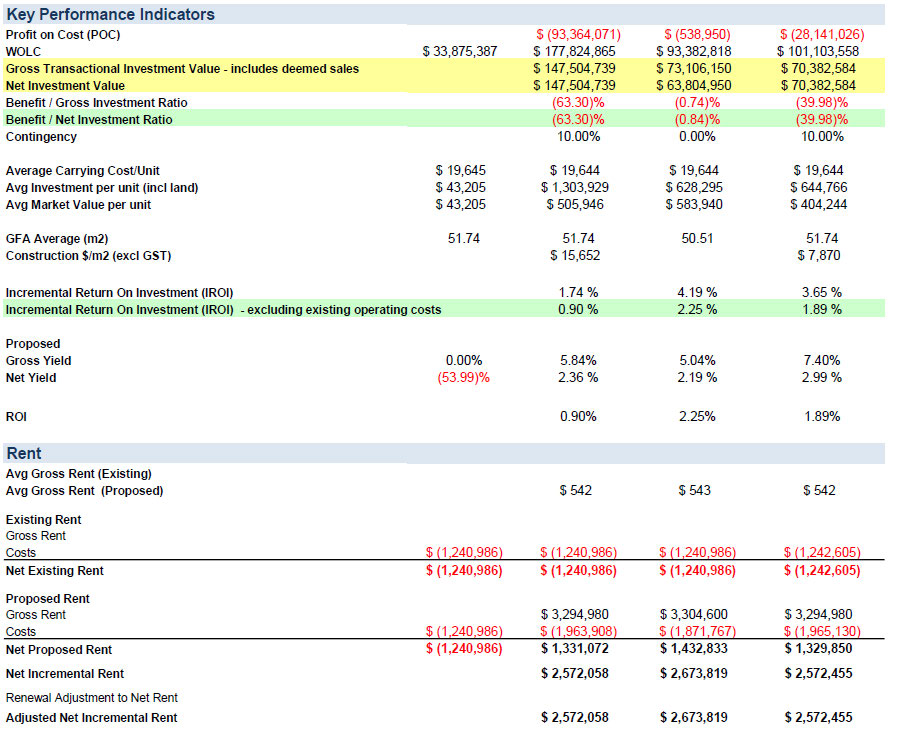 Appendix 6 – Financial Analysis of Options and
associated assumptions
Appendix 6 – Financial Analysis of Options and
associated assumptions
1982
Act
Information
Official
the
under
Released
General assumptions:
1. The costs in the options analysis are exclusive of GST and values and rents are inclusive of GST if any.
Values:
1. Net Book Value is based on the value inclusive of depreciation, showing the lower number of
approximately $2,298,366 (rounded).
2. The “as is” value (CMV) of $4,510,000 for existing units was obtained from the valuation completed
by an independent valuer, dated January 2025.
3. The same values used in point 2 above were used as the completion values for the “Do nothing”
option.
4. The “on completion” values for full remediation (Option 2a) are based on the December 2024
valuation.
5. The “on completion” values for minimum scope remediation (Option 2b) are based on 80% of the
fully remediated values in the December 2024 valuation.
6. Values on completion for the Divestment option were extrapolated from transactions concluded by
Kainga Ora and in the open market, for residential units near 134 Dixon Street. This was a high-level
estimation of cost to replace the same number of units.
1982
Rents:
Act
7. Rents for completed units were taken from the December 2024 valuation and adjusted, based on
market trends and recent benchmark valuations.
8. The same rents were used for both remediation options and acquire new option, as the consensus is
that tenants/ customers would likely not differentiate between the three options in terms of rental
rates payable.
Information
Costs:
9. Costs for remediation - ful scope option based on 50% detailed design development and costed by
a Quantity Surveyor in December 2024. Official
10. Costs for remediation - minimum scope option extrapolated by Quantity Surveyor based on Ful
scope remediation option and without the benefit of detailed design documentation. On that basis,
the
there is a higher level of risk associated with the costs for this option.
11. Contingency - For remediation options, a 10% contingency is used. This is higher than the average
8%, given the nature of the building. No contingency allowed for in sell and replace because
under
contingency built into assumed sales prices.
12. For Do Nothing option, an additional rental cost was added, which is based on actual ongoing
operational expenditure/ holding cost (security, routine and responsive maintenance) of $133,736
per annum.
13. Timeframe to completion is 44 months for full scope remediation option, 40 months for minimum
scope remediation option
Released to align with assumptions in Quantity Surveyors estimate.
1982
Act
Information
Official
the
under
Released
1982
Act
Information
Official
the
under
Released
