 Document 1
Out of scope
From:
National Curriculum Refresh
Sent:
Friday, 30 May 2025 6:07 pm
To:
National Curriculum Refresh
Cc:
Curriculum Review
Subject:
Helping us update The New Zealand Curriculum: Focus Group
Tēnā koutou,
Thank you for your time and nominations for the
Focus Group review. We were pleased to receive a high volume of
1982
interest from subject matter experts willing to contribute their time and insights to this important work.
Because of this, it has taken longer than planned to communicate the outcome of this process. We appreciate
your patience during this time.
ACT
To accommodate the strong interest, we’ve expanded the size of the Review Groups beyond our original
expectations. However, we regret that we’re still unable to o er a role to everyone who put their name forward.
We’re now in the process of contacting those people who will be invited to join the Review Groups to provide
further information about next steps and timing for the first sessions.
For those we couldn’t invite at this time, we will continue to advise of future opportunities to contribute to the
development of curriculum content. Updates on these will be shared with you as key sector groups and published
on the Ministry’s Tāhūrangi website at tahurangi.education.govt.nz and tahurangi.education.govt.nz/our-story.
If you have any questions or would like to discuss the Focus Review group further, please contact us at our new
Review Group mailbox – [email address] . INFORMATION
Ngā mihi,
Lauren Flohr | Programme Advisor
Te Poutāhū (Curriculum Centre)
education.govt.nz
OFFICIAL
He mea tārai e mātou te mātauranga kia rangatira ai, kia mana taurite ai ōna huanga We shape an education system that delivers equitable and excellent outcomes
THE
UNDER
RELEASED
1
1982
ACT
INFORMATION
OFFICIAL
THE
UNDER
RELEASED
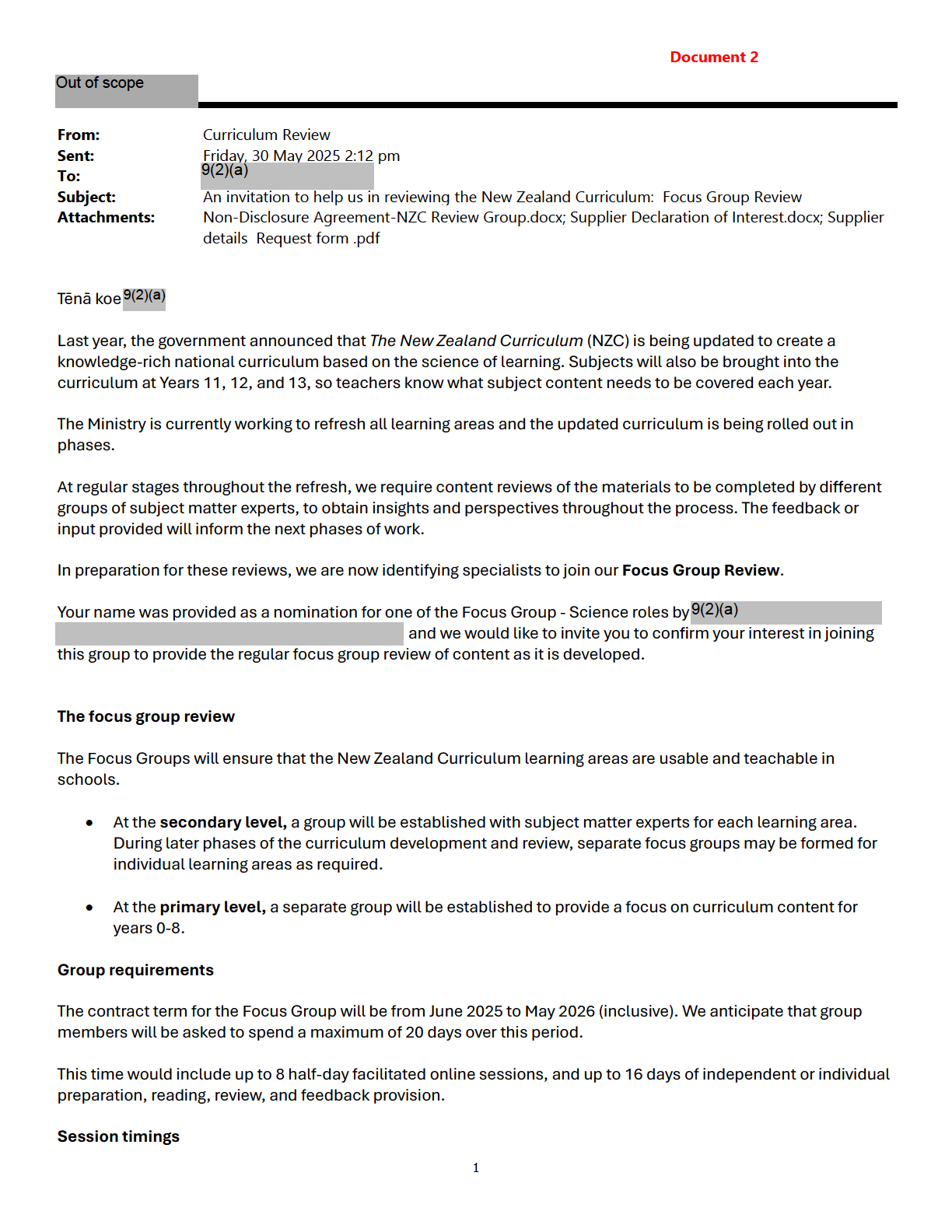
The Focus Group will attend one half-day online onboarding and introductory session in July 2025. This is
anticipated for the week of 2 – 11 July and will be held during business or ordinary working hours. Invitations and
further details will be sent separately. The purpose is to provide members with an understanding of the curriculum
development and design approach and how this aligns with the focus and expected outcomes of a knowledge-rich
curriculum.
Group members will then meet once a month from late-July to late-October / early-November 2025 to review
curriculum content and materials as they are developed and available at each point. These will take the form of a
half-day online meeting and will be organised for the same time each month where possible to support planning.
Draft content will be provided to group members prior to each session for preparation and review. If required,
1982
group members may be asked to complete and return review feedback individually after each session. Feedback
forms will be provided to support this activity.
ACT
Further sessions will be organised in Term 1, 2026 to review the outcomes from wider in-class testing and
consultation, and to provide an early view of the Final Curriculum content. Teacher and principal members of the
Focus Groups will also be invited to support and participate in the in-class testing that is proposed for Term 1,
2026. This activity will be planned with participants separately.
Contract and remuneration
Membership and contribution to the review groups will be covered under a Contract or Memorandum of
Understanding (MoU) and will include remuneration at a daily fee of $406.38 (plus GST if applicable) noting any
INFORMATION
part-day will be charged on a pro rata basis (a day is no less than 8 hours).
This fee has been set in accordance
with the Cabinet Fees Framework [Cabinet O ice Circular (22)2] for all group members.
Once you confirm your interest in joining the Focus Group Review, this documentation will be provided for your
review and acceptance.
OFFICIAL
For those working in schools or tertiary institutions, the Ministry contracts the school or tertiary institution and will
provide funding at the above rate to cover your absence for the purpose of providing services to the Ministry during
work time. This would include attending online meetings, preparation, and review time related to the Review
THE
Groups.
For those not working in schools and tertiary institutions, or those teaching in private schools, payment will be
made directly to you.
UNDER
Confirming your interest
If you would like to confirm your interest in joining the Focus Group Review, please reply to this email by 6 June
2025.
Please accompany your confirmation with:
RELEASED
• a completed and signed
non-disclosure agreement
• a completed and signed
conflict of interest declaration.
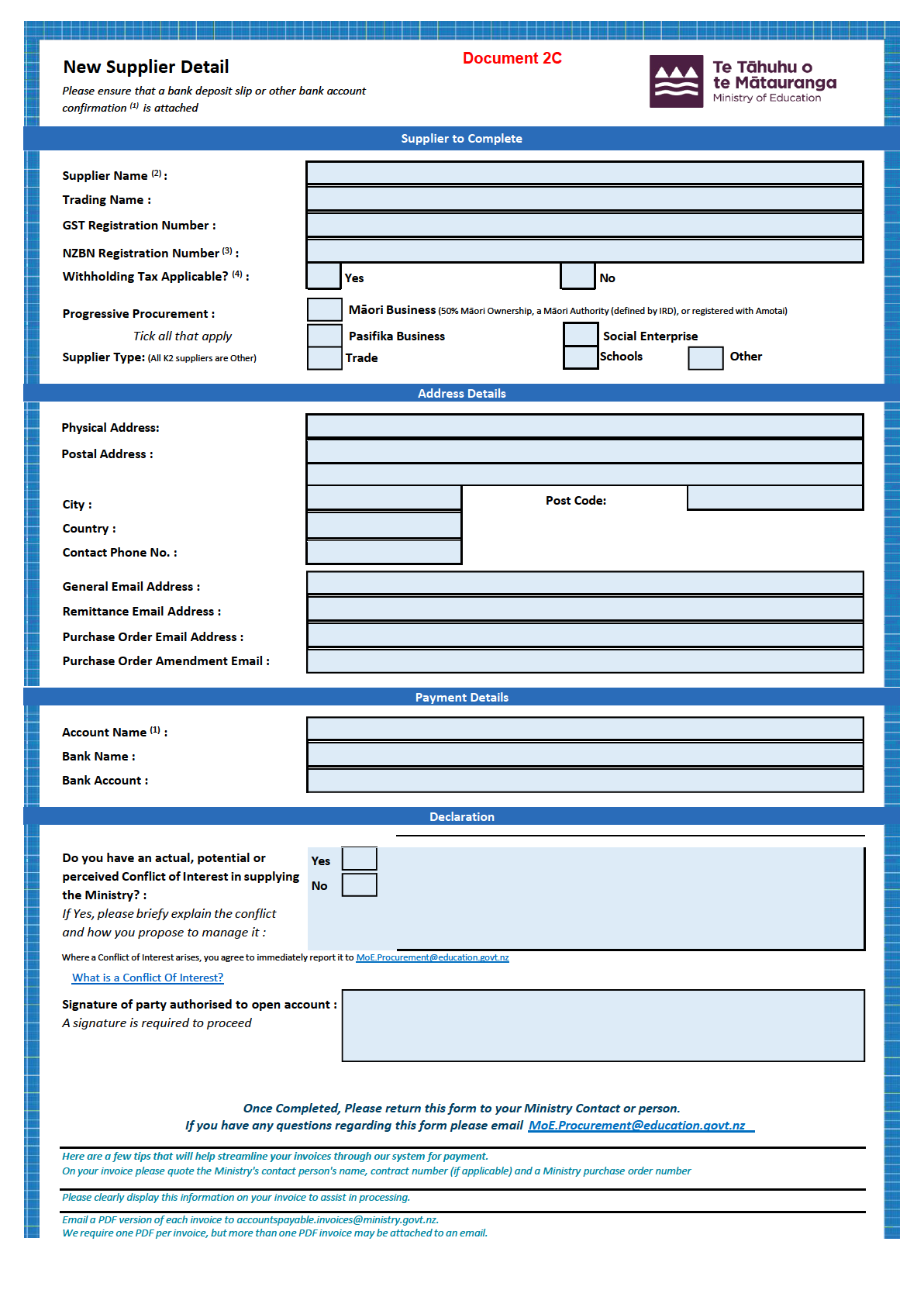
If this is the first time you will be delivering work for the Ministry, or if you have not delivered work for the Ministry in
the last 12 months, please also complete and return the attached
New Supplier Form.
2

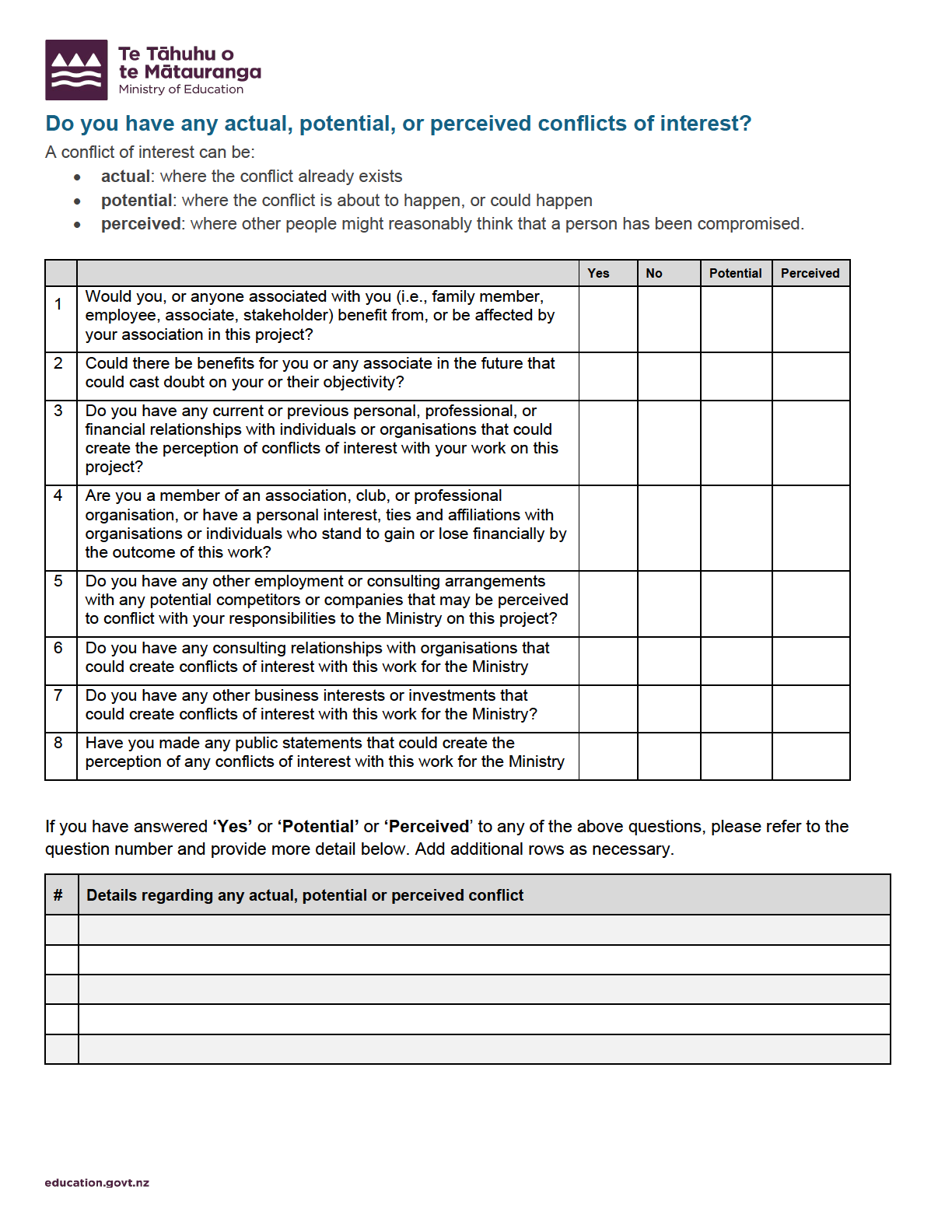
The above documents are attached to this email. The conflict-of-interest declaration keeps you and the Ministry
safe and ensures any perceived or potential or actual conflicts can be managed, giving confidence in the
engagement and contracting decisions we make.
Please also provide us with or confirm the following information so that we can prepare your contract.
• Your full name
• Your postal address
• Your cell phone number
• Your preferred email address
If you are a teacher or senior leader working in a (not private) school, please also provide:
• the name of the school
1982
• the name of the school’s principal
Or
ACT
If you are working for yourself, are a teacher in a private school, or will be conducting this work in your role in an
organisation or university, please advise the following.
• the name of the Supplier (ie the name of the organisation, or if you are working for yourself, this will be your
name)
•
Supplier’s NZBN number (if registered as a NZ Business)
•
Supplier’s physical address
•
Supplier’s postal address
•
Supplier’s Contract Manager’s name (ie the name of the person who will be responsible for signing the
contract, if this is di erent to yourself)
INFORMATION
•
Supplier’s Contract Manager’s title
•
Supplier’s Contract Manager’s email
•
Supplier’s Contract Manager’s phone number
If you have any questions or would like to discuss the Focus Group Review further, please also send these by
return email.
OFFICIAL
Ngā mihi,
THE
Lauren Flohr | Process Planner
Te Poutāhū (Curriculum Centre)
DDI +6444630934 | 9(2)(a)
National Office 1 The Terrace
UNDER
education.govt.nz
He mea tārai e mātou te mātauranga kia rangatira ai, kia mana taurite ai ōna huanga We shape an education system that delivers equitable and excellent outcomes
RELEASED
3
 Document 2A
Non-Disclosure Agreement (One-way)
Document 2A
Non-Disclosure Agreement (One-way)
Ministry
Ministry of Education
(Ministry)
Recipient
[Insert Name]
(You)
Introduction
A.
Ministry has agreed to supply you with information about the refreshed New
Zealand Curriculum, so that you can provide reviews and feedback
(Project).
B.
The parties have agreed to enter into this agreement to record the terms on which
You will keep confidential any content and information disclosed to You by the
Ministry.
1982
In consideration for, among other things, the supply of information by Ministry to You, the
parties agree:
1.
Definition
ACT
Confidential Information means, regardless of the form of disclosure or the medium used to store it,
any information disclosed or made available by or on behalf of Ministry to You relating to the Ministry or
any aspect of the Project or the business of Ministry (current and future) and includes (without
limitation) information provided before the date of this document and any copies of the above
information or material derived from that information.
2.
Property
All Confidential Information is and will remain the property of Ministry.
3.
Confidentiality obligations
3.1 Subject to clause 4, You must:
INFORMATION
(a)
keep the Confidential Information in strict confidence;
(b)
take diligent precautions to preserve the confidentiality of the Confidential Information;
(c)
not disclose the Confidential Information to any person (other than in accordance with clauses 4
and 5);
(d)
use the Confidential Information only for the purposes of the Project or authorised in writing by
Ministry at any time;
(e)
make copies or excerpts of the Confidential Information only to the extent strictly necessary for
OFFICIAL
the purposes authorised in writing by Ministry at any time;
(f)
if reasonably requested by Ministry, return to Ministry or destroy all of the Confidential
Information, including copies and digital files and provide written confirmation that all files and
THE
copies have been destroyed or returned; and
(g)
take all necessary action to prevent any unauthorised person obtaining access to the Confidential
Information.
3.2 You must procure that the people You disclose the Confidential Information to in accordance with this
agreement comply with this agreement. You will be deemed to be in breach of this agreement if anyone
UNDER
You disclose Confidential Information to fails to comply with this agreement.
3.3 Nothing in this clause 3 requires or entitles either party to do anything in breach of any statutory or
regulatory obligation or in breach of any confidentiality obligation owed to a third party.
4.
Exceptions
Clause 3 applies except:
(a)
where Ministry has given written consent to the Confidential Information being released to a
RELEASED
specific person;
(b)
if the Confidential Information is generally and publicly available other than as a result of a breach
of this agreement by You;
(c)
to Confidential Information lawfully in Your possession before it was disclosed or made available
under this agreement and which is not itself the subject of any other confidentiality restrictions;
(d)
to Confidential Information legally obtained from a third party who is free to disclose it; or
(e)
if disclosure of the Confidential Information is required by law or Stock Exchange requirement (in
which case You must first notify Ministry of this requirement, provide Ministry with a copy of the
Confidential Information to be disclosed and take all steps reasonably required by Ministry to
prevent or limit the disclosure).
20220407_Ministry of Education_Non-Disclosure Agreement (One-way)_TM_2022
5.
Announcements
Unless required to by law, You wil not make any public announcements about this document, the Project
or Your discussions with Ministry, without the prior written consent of Ministry.
6.
Term
This agreement will remain in force for so long as you hold Confidential Information or the date on which
all Confidential Information has entered the public domain.
7.
Indemnity
1982
You indemnify and hold harmless Ministry and their respective officers, employees, agents and
consultants against all actions proceedings, losses, liabilities, damages, claims, demands, costs and
expenses (including legal fees and expenses on a solicitor client basis) suffered or incurred by them as a
ACT
result of or arising from any breach, by You of your obligations under this agreement.
8.
Governing Law
This document is governed by the laws of New Zealand, and the parties submit to the non-exclusive
jurisdiction of the courts of New Zealand.
9.
Relationship
Nothing in this document will be deemed to constitute either party as the agent, partner or joint
venturer of the other.
10.
Injunctive relief
You acknowledge that monetary damages alone may be an inadequate remedy for breach of your
obligations under this agreement. In addition to any other remedy which may be available in law or
equity, Ministry is entitled to equitable relief including an injunction and an order for specific
INFORMATION
performance of this agreement.
11.
No waiver
A party’s failure or delay to exercise a power or right is not a waiver of that power or right, and the
exercise of a power or right does not preclude the future exercise of that or any other power or right.
Executed as an agreement
Signed by (Insert Name)
Signed for and on behalf of the
Ministry of
OFFICIAL
Education by:
Derek Lyons
THE
Signature.................................................
Signature...............................................
UNDER
Date:
RELEASED
20220407_Ministry of Education_Non-Disclosure Agreement (One-way)_TM_2022
2

 Document 2B
Declaration of interests
Document 2B
Declaration of interests
A Conflict of Interest is a circumstance where an individual has a personal interest, obligation, loyalty, or
relationship that may influence or be perceived to influence the performance of their responsibilities of their
job/position.
A conflict:
• can exist where the interest or relationship means you are biased.
• can exist where someone looking in from the outside could have reasonable grounds to think you might be
1982
biased.
• may call the individual’s independence, objectivity, or impartiality into question.
• may include past, current, or possible future interests, obligations, loyalties, bias, or relationships that an
ACT
individual or someone associated with the individual (e.g. family members, friends) may have.
Position nominated or selected for:
Your ful legal name:
Your name you are known by (if this is dif erent to your
legal name)
:
Your address:
INFORMATION
Your email:
Your employer or the organisation you are
representing while doing this work:
OR if you are doing this work independently, please
write ‘independent’:
OFFICIAL
Your declaration
THE
I confirm/agree that:
• to the best of my knowledge, the above details are correct
• I make this declaration in good faith.
• The Ministry of Education may discuss any of the interests that I have disclosed, in confidence, with parties to
UNDER
which this appointment relates to.
• The Ministry of Education may carry out probity checks on me.
Signed:
Date:
Your employer’s or representing organisation’s declaration
(if you are not doing this work
RELEASED
independently)
I confirm/agree that I am aware of this declaration.
Signed:
Date:
Position:
1982
ACT
INFORMATION
OFFICIAL
THE
UNDER
RELEASED

 Conflict of Interest Management Plan
The relevant manager at the Ministry will complete this plan when you declare a conflict of interest.
How the conflict of interest wil be managed
The fol owing plan has been agreed to manage your declared conflict of interest. This takes into account the
conflict’s likely effect on your role and responsibilities to the project, as well as the risks to the process and the
1982
Ministry’s reputation.
ACT
INFORMATION
OFFICIAL
Declaration – I agree to the above Conflict of Interest Management Plan
THE
Signature:
Person making the declaration:
Date:
UNDER
Approval – I approve the above Conflict of Interest Management Plan and confirm the
conflict has been resolved:
Signature:
RELEASED
Relevant manager’s name:
Date:
1982
ACT
INFORMATION
OFFICIAL
THE
UNDER
RELEASED

1982
ACT
INFORMATION
OFFICIAL
THE
UNDER
RELEASED
1982
ACT
INFORMATION
OFFICIAL
THE
UNDER
RELEASED
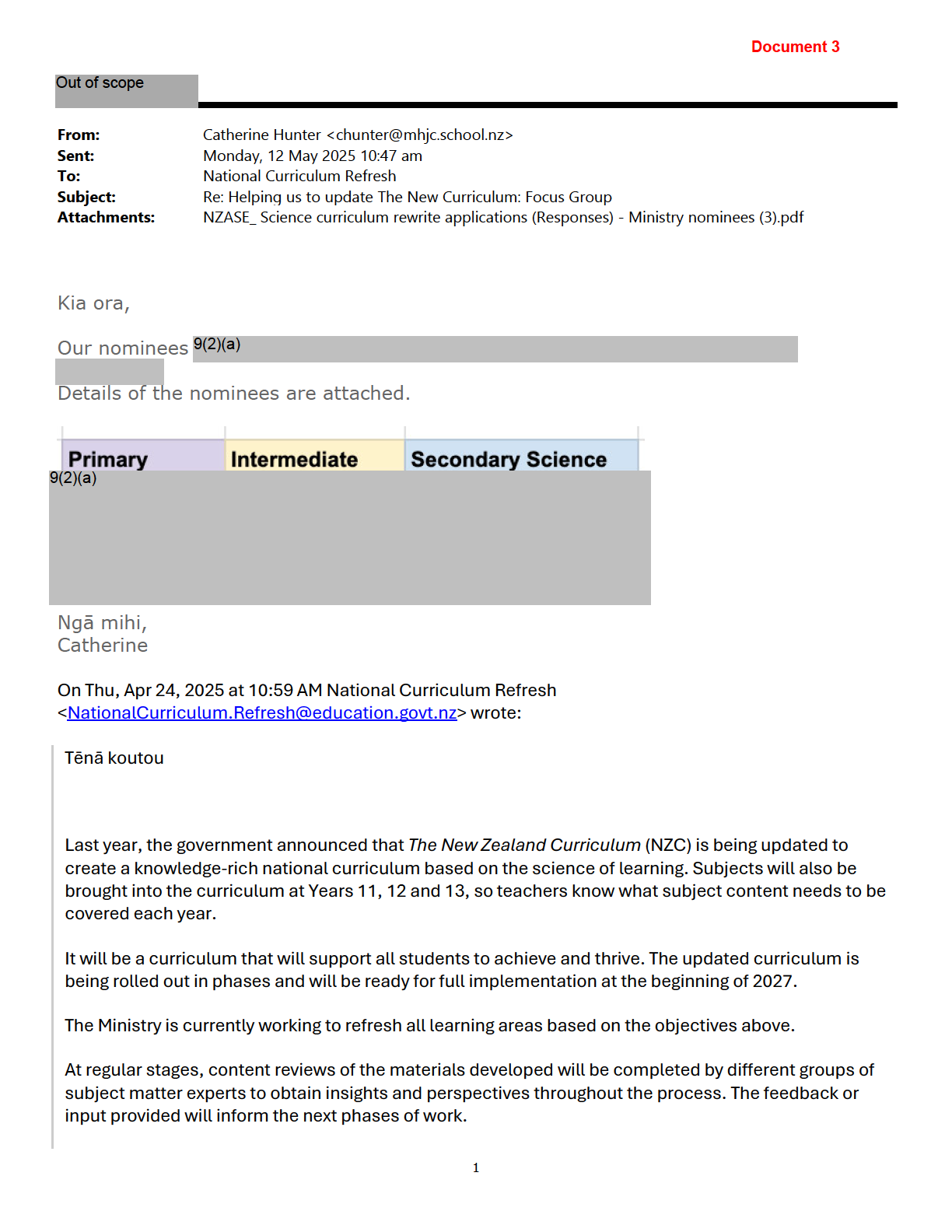
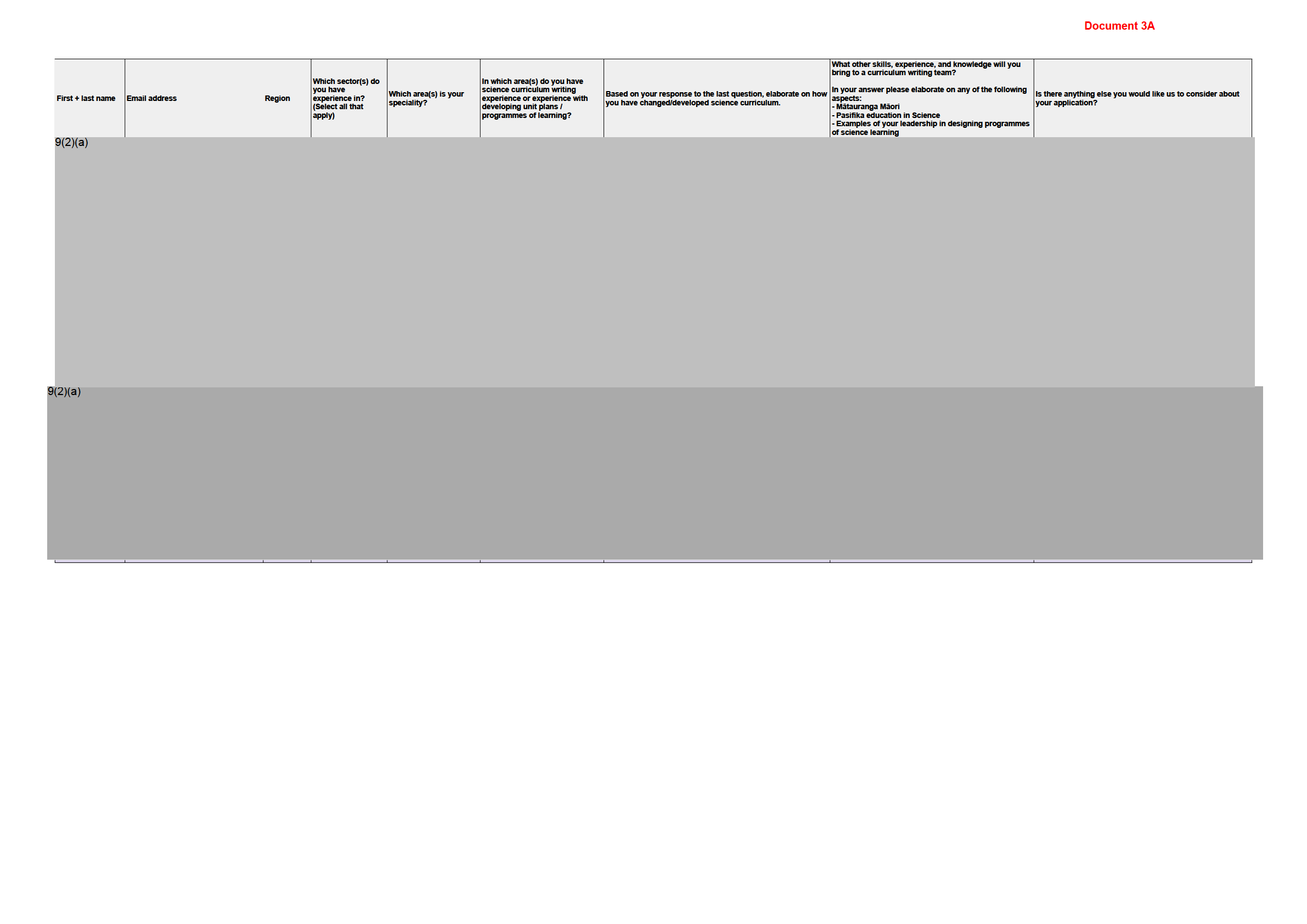
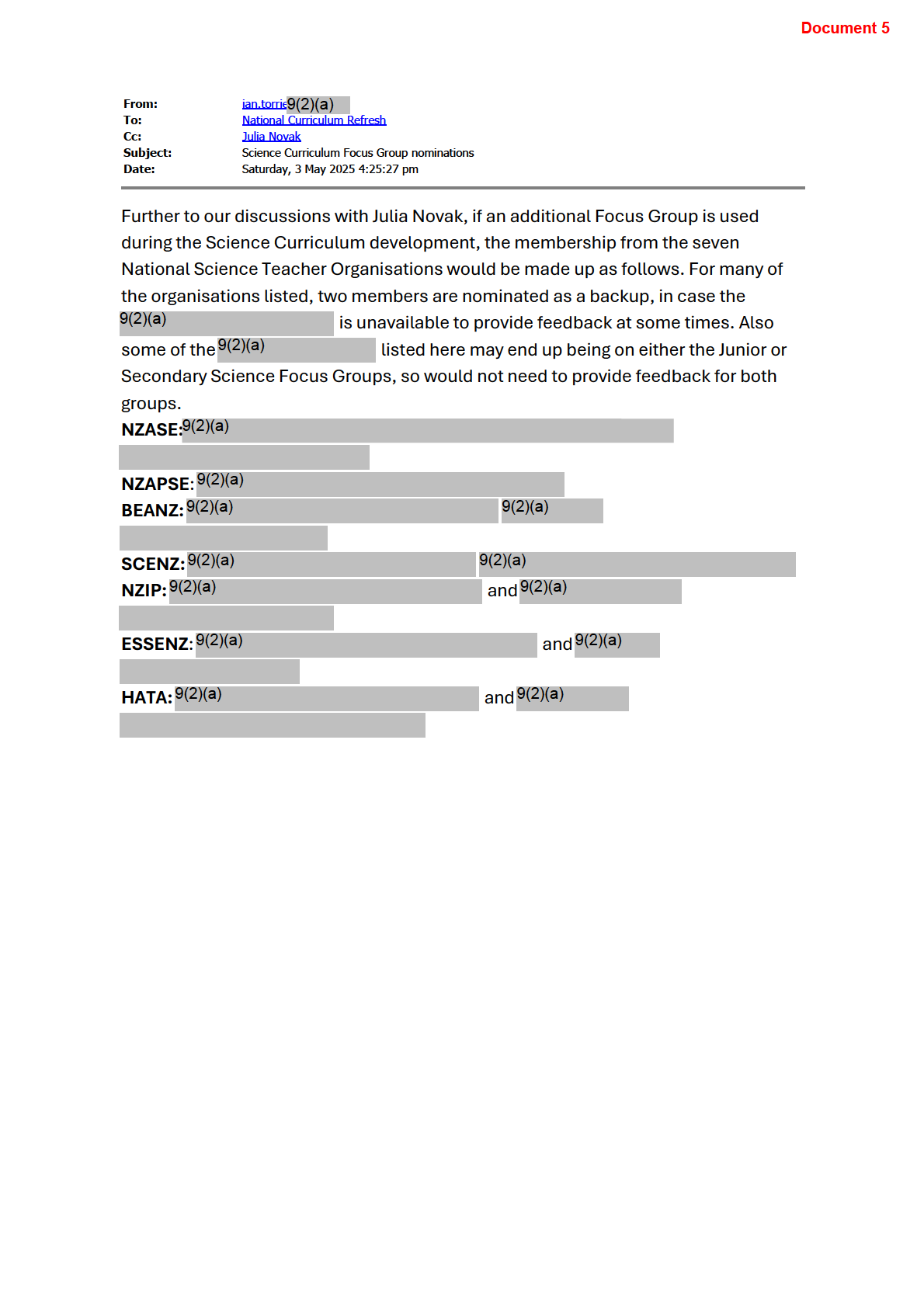
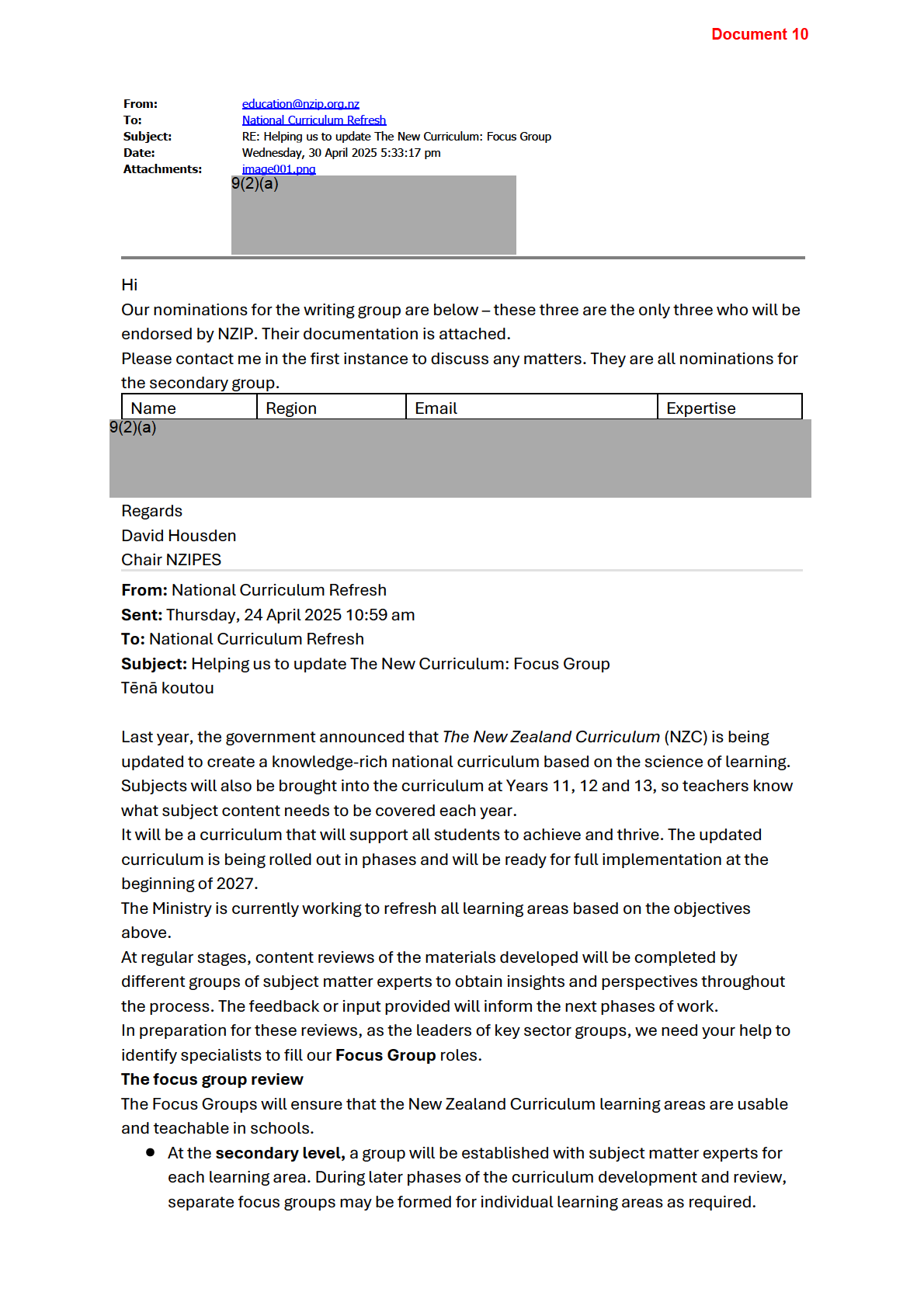
In preparation for these reviews, as the leaders of key sector groups, we need your help to identify
specialists to fill our
Focus Group roles.
The focus group review
The Focus Groups will ensure that the New Zealand Curriculum learning areas are usable and
teachable in schools.
• At the
secondary level, a group will be established with subject matter experts for each learning
area. During later phases of the curriculum development and review, separate focus groups may
be formed for individual learning areas as required.
1982
• At the
primary level, a separate group will be established to provide a focus on curriculum
content for years 0-8.
ACT
The two Focus Groups will attend three onboarding and introductory sessions, one each in late-May,
late-June, and mid-July 2025. The purpose of these is provide members with an understanding of the
curriculum development and design approach and how this aligns with the requirements and expected
outcomes of the group.
INFORMATION
Group members will then meet once a month from late July to October 2025 to review curriculum
content and materials as they are developed and available at each point. These will take the form of an
online or in-person meeting and will be organised for the same time each month where possible to
support planning.
Further sessions will be organised in Term 1, 2026 to review the outcomes from wider in-class testing
OFFICIAL
and consultation, and to provide an early view of the Final Curriculum content. Teacher and Principal
members of the Focus Groups will also be invited to support and participate in the in-class testing that
is proposed for Term 1, 2026.
THE
What we need from you
We are seeking a wide range of perspectives from members of the New Zealand Curriculum Review
UNDER
Groups.
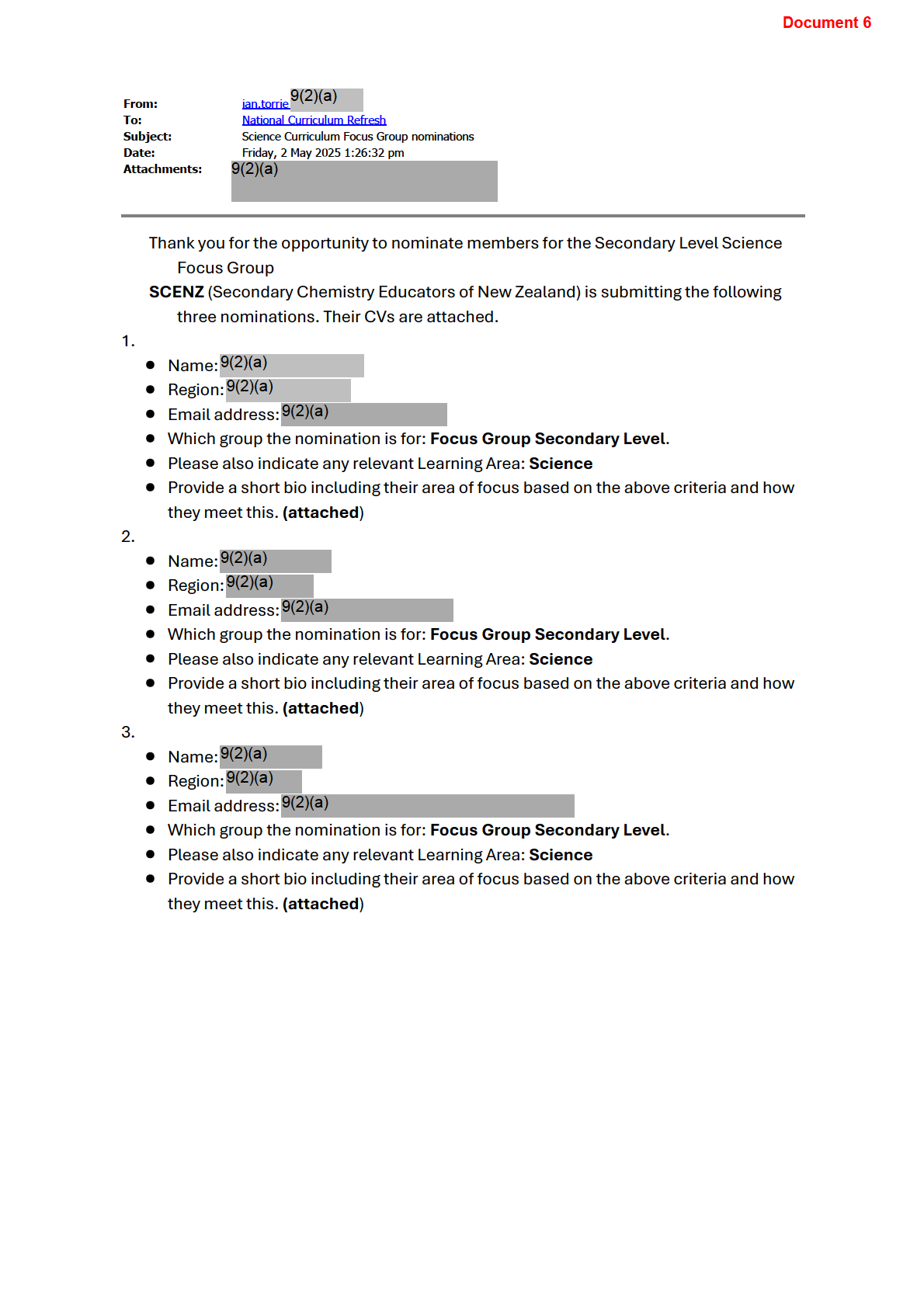
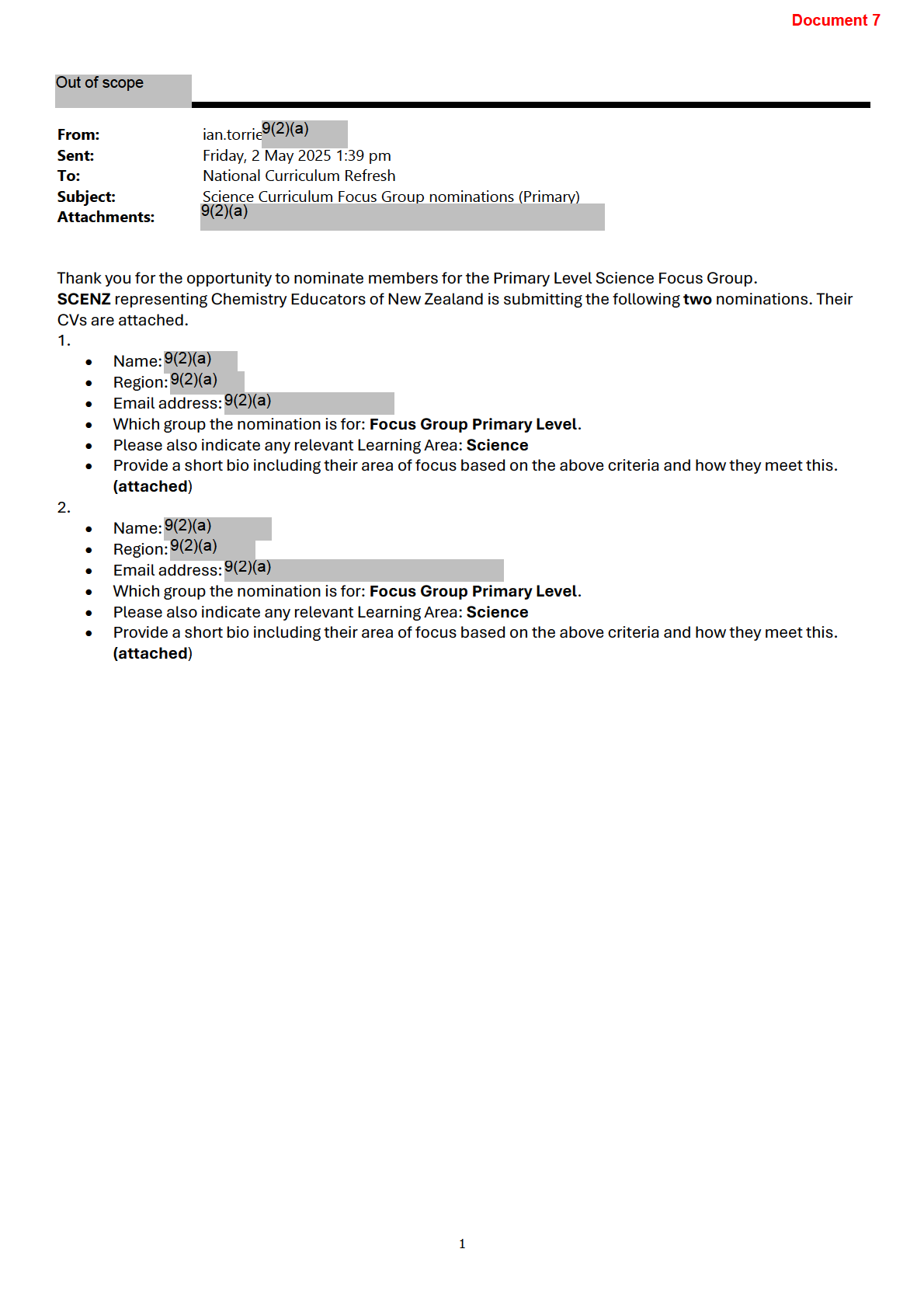
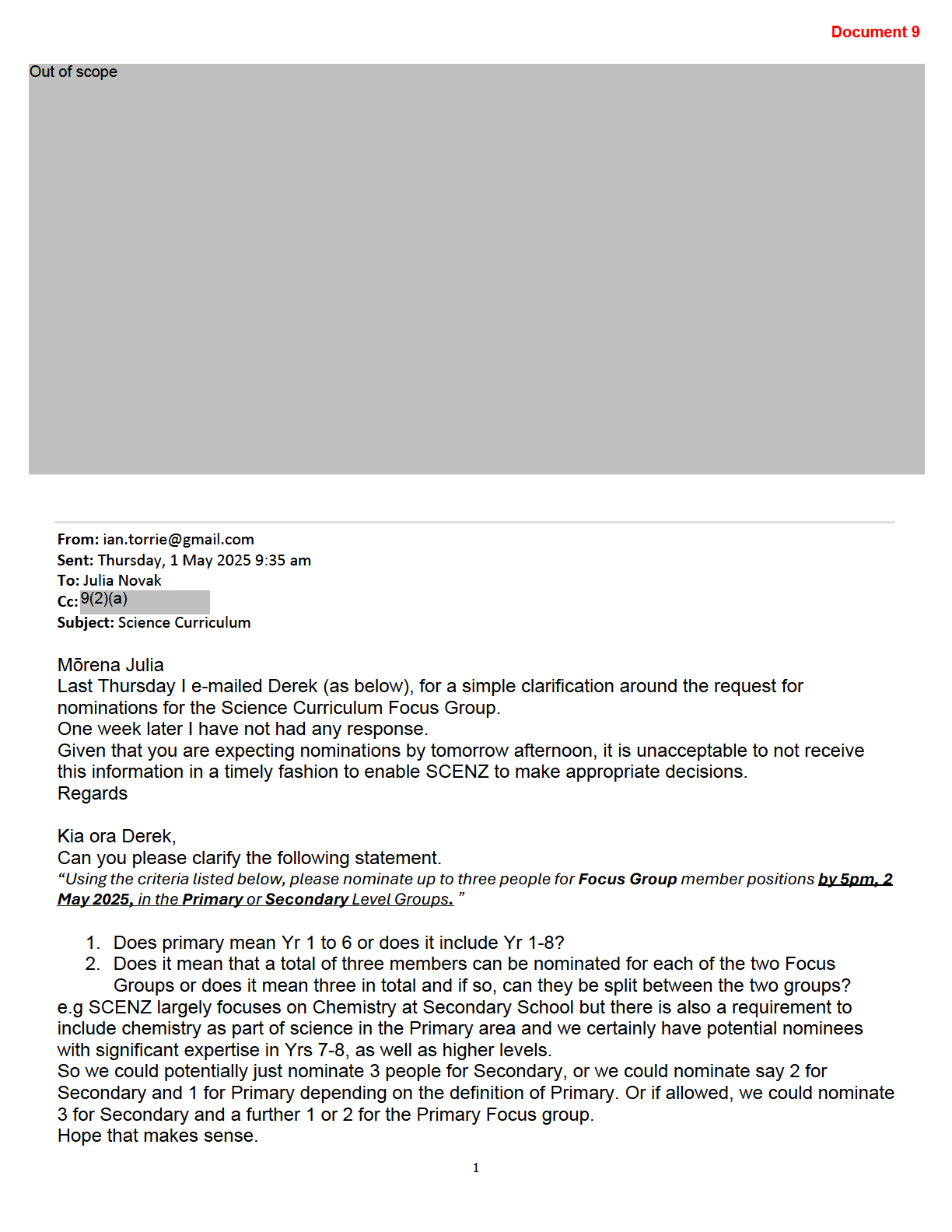
Using the criteria listed below, please nominate up to three people for
Focus Group member positions
by 5pm, 2 May 2025, in the
Primary or
Secondary Level Groups
.
RELEASED
Criteria for Focus Group members
Nominations should reflect credible educators who demonstrate strong evidence of, and experience in,
curriculum integration and a combination of the following:
a. Relevant content knowledge of national and international research
b. Relevant curriculum knowledge for a primary context and/or
2
c. Relevant curriculum knowledge for a secondary context
d. Understanding of best practice pedagogy and current teaching experience in the NZC
e. Experience and expertise in working in diverse settings, including with ākonga Māori and in
schools with high Pacific rolls.
Please send details of your nominee/s along with their:
• Name
1982
• Region
• Email address
ACT
• Which group the nomination is for –
Focus Group Primary Level or
Focus Group Secondary
Level.
• Please also indicate any relevant Learning Area (Science, Technology, Arts, Social Sciences,
Health and Physical Education, Learning Languages)
• Provide a short bio including their area of focus based on the above criteria and how they meet
this.
INFORMATION
Please return all nominations to [email address].
To ensure the credibility of the applicants, we are unable to consider EOIs that have not been endorsed
OFFICIAL
by your organisation, as we will not be undergoing reference checking. Whether the nominations are
sent directly from the organisations, or by the individuals being nominated, please ensure the
endorsement of each application is clearly stated
THE and that the applicant/s have agreed to be
nominated.
A contract that describes the scope of services will be provided to all invited group members for their
review and acceptance. UNDER
How we would like to work with your organisation
As part of our ongoing relationship with your organisation, we hope to continue to work together to
design and implement the NZC. Review Groups and their structure may flex across phases to support
RELEASED
the developing curriculum content, changing expertise requirements, and availability. This may see
group numbers, size, and membership change at different stages.
We will send you the list of successful candidates for the Focus Group after this initial process has
been completed.
3



We appreciate you taking the time to consider our request for submitting a nominee or nominees.
If you have any concerns with the timelines outlined, have any questions, or would like more
information, please email [email address] .
Ngā mihi,
The New Zealand Curriculum Refresh Team
Te Poutāhū (Curriculum Centre)
1982
National Office 1 The Terrace
education.govt.nz
ACT
He mea tārai e mātou te mātauranga kia rangatira ai, kia mana taurite ai ōna huanga We shape an education system that delivers equitable and excellent outcomes
INFORMATION
DISCLAIMER:
This email and any attachments may contain information that is confidential and subject to legal privilege. If you are not the intended recipient, any use,
dissemination, distribution or duplication of this email and attachments is prohibited. If you have received this email in error please notify the author
immediately and erase all copies of the email and attachments. The Ministry of Education accepts no responsibility for changes made to this message or
OFFICIAL
attachments after transmission from the Ministry.
THE
UNDER
RELEASED
4
1982
ACT
INFORMATION
OFFICIAL
THE
UNDER
RELEASED
1982
ACT
INFORMATION
OFFICIAL
THE
UNDER
RELEASED
1982
ACT
INFORMATION
OFFICIAL
THE
UNDER
RELEASED
1982
ACT
INFORMATION
OFFICIAL
THE
UNDER
RELEASED


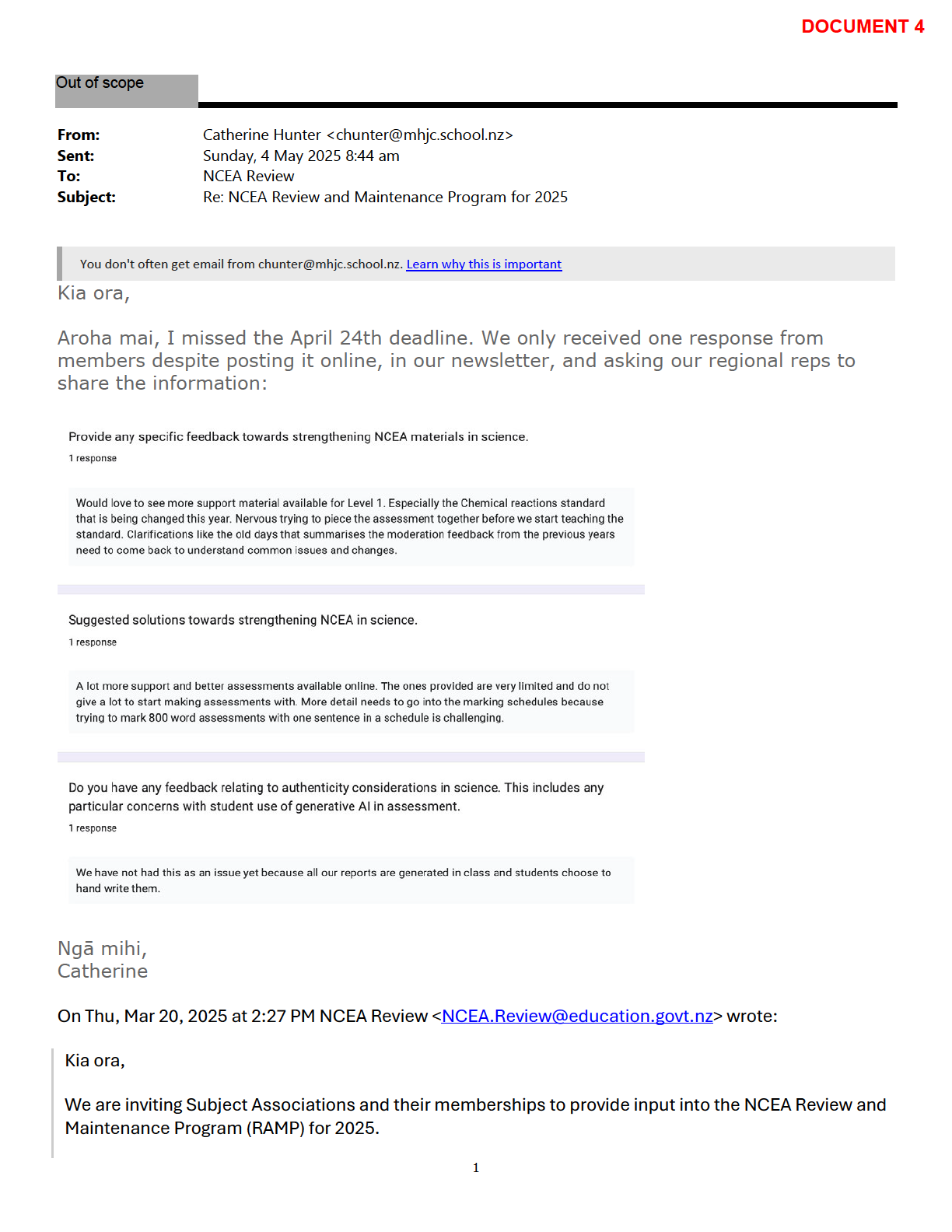
The annual RAMP work programme aims to strengthen assessment materials across the three levels of
NCEA. Most RAMP updates are made to improve clarity and interpretation. Your input into this process
is particularly valued, because your membership is made up of classroom teachers who work with
NCEA materials first hand.
In your response to this email please let us know:
•
any specific feedback from your membership towards strengthening NCEA materials in your
subject area
•
any suggested solutions that your membership has already discussed
•
any specific points relating to authenticity considerations in your subject area. This includes
1982
any particular concerns with student use of generative AI in assessment.
We ask for you to respond by April 24th so we can collate input from all contributors and begin RAMP
ACT
work in May. After that point there may be a need for further contact with you to clarify your input and
collaborate on the work involved.
Ngā mihi,
The NCEA Review Team
National Office 1 The Terrace
INFORMATION
education.govt.nz
He mea tārai e mātou te mātauranga kia rangatira ai, kia mana taurite ai ōna huanga We shape an education system that delivers equitable and excellent outcomes
OFFICIAL
THE
DISCLAIMER:
UNDER
This email and any attachments may contain information that is confidential and subject to legal privilege. If you are not the intended recipient, any use,
dissemination, distribution or duplication of this email and attachments is prohibited. If you have received this email in error please notify the author
immediately and erase all copies of the email and attachments. The Ministry of Education accepts no responsibility for changes made to this message or
attachments after transmission from the Ministry.
RELEASED
2
1982
ACT
INFORMATION
OFFICIAL
THE
UNDER
RELEASED
1982
ACT
INFORMATION
OFFICIAL
THE
UNDER
RELEASED
1982
ACT
INFORMATION
OFFICIAL
THE
UNDER
RELEASED
 Document 8
Out of scope
From:
National Curriculum Refresh
Sent:
Thursday, 1 May 2025 4:04 pm
To:
National Curriculum Refresh
Subject:
EOI for Review Group nominations extended by one week
Tēnā koutou katoa
Further to our earlier communications about seeking nominations for our New Zealand Curriculum Review Groups
1982
via an Expression of Interest process, we wish to advise that we are now extending the EoI deadline to
5pm, Friday
9 May 2025.
ACT
We appreciate there are some organisations who need a bit more time to prepare their nominations and it is
important to us that we can o er some additional space to support an informed and considered process for all
involved. While we have provided an extra week for the EoI, we would appreciate your nominations as soon as
possible.
We would also like to remind you that we are running an ongoing FAQ process where we will provide relevant
responses and further information to questions received via this mailbox here: Tāhūrangi (under the drop-down
called
Review Group Nomination FAQs).
INFORMATION
Our sincere thanks to those who have already sent in their nominations.
Ngā mihi nui
The New Zealand Curriculum Refresh Team
Te Poutāhū (Curriculum Centre)
OFFICIAL
National Office 1 The Terrace
education.govt.nz
THE
He mea tārai e mātou te mātauranga kia rangatira ai, kia mana taurite ai ōna huanga We shape an education system that delivers equitable and excellent outcomes
UNDER
RELEASED
1
1982
ACT
INFORMATION
OFFICIAL
THE
UNDER
RELEASED
1982
ACT
INFORMATION
OFFICIAL
THE
UNDER
RELEASED
At the
primary level, a separate group will be established to provide a focus on
curriculum content for years 0-8.
The two Focus Groups will attend three onboarding and introductory sessions, one each in
late-May, late-June, and mid-July 2025. The purpose of these is provide members with an
understanding of the curriculum development and design approach and how this aligns
with the requirements and expected outcomes of the group.
Group members will then meet once a month from late July to October 2025 to review
curriculum content and materials as they are developed and available at each point. These
will take the form of an online or in-person meeting and will be organised for the same time
each month where possible to support planning.
1982
Further sessions will be organised in Term 1, 2026 to review the outcomes from wider in-
class testing and consultation, and to provide an early view of the Final Curriculum
ACT
content. Teacher and Principal members of the Focus Groups will also be invited to
support and participate in the in-class testing that is proposed for Term 1, 2026.
What we need from you We are seeking a wide range of perspectives from members of the New Zealand
Curriculum Review Groups.
Using the criteria listed below, please nominate up to three people for
Focus Group
member positions
by 5pm, 2 May 2025, in the
Primary or
Secondary Level Groups
.
INFORMATION
Criteria for Focus Group members
Nominations should reflect credible educators who demonstrate strong evidence of, and
experience in, curriculum integration and a combination of the following:
a. Relevant content knowledge of national and international research
b. Relevant curriculum knowledge for a primary context and/or
OFFICIAL
c. Relevant curriculum knowledge for a secondary context
d. Understanding of best practice pedagogy and current teaching experience in the
THE
NZC
e. Experience and expertise in working in diverse settings, including with ākonga Māori
and in schools with high Pacific rolls.
Please send details of your nominee/s along with their:
UNDER
Name
Region
Email address
Which group the nomination is for –
Focus Group Primary Level or
Focus Group
Secondary Level.
Please also indicate any relevant Learning Area (Science, Technology, Arts, Social
RELEASED
Sciences, Health and Physical Education, Learning Languages)
Provide a short bio including their area of focus based on the above criteria and how
they meet this.
Please return all nominations to [email address].
To ensure the credibility of the applicants, we are unable to consider EOIs that have not
been endorsed by your organisation, as we will not be undergoing reference checking.

Whether the nominations are sent directly from the organisations, or by the individuals
being nominated, please ensure the endorsement of each application is clearly stated and
that the applicant/s have agreed to be nominated.
A contract that describes the scope of services will be provided to all invited group
members for their review and acceptance.
How we would like to work with your organisation As part of our ongoing relationship with your organisation, we hope to continue to work
together to design and implement the NZC. Review Groups and their structure may flex
across phases to support the developing curriculum content, changing expertise
requirements, and availability. This may see group numbers, size, and membership change
1982
at different stages.
We will send you the list of successful candidates for the Focus Group after this initial
ACT
process has been completed.
We appreciate you taking the time to consider our request for submitting a nominee or
nominees.
If you have any concerns with the timelines outlined, have any questions, or would like
more information, please email [email address] .
Ngā mihi,
INFORMATION
The New Zealand Curriculum Refresh Team
Te Poutāhū (Curriculum Centre)
National Office 1 The Terrace
education.govt.nz
OFFICIAL
He mea tārai e mātou te mātauranga kia rangatira ai, kia mana taurite ai ōna huanga We shape an education system that delivers equitable and excellent outcomes
THE
UNDER
DISCLAIMER:
This email and any attachments may contain information that is confidential and subject to legal privilege. If you are not the intended
recipient, any use, dissemination, distribution or duplication of this email and attachments is prohibited. If you have received this email in
error please notify the author immediately and erase all copies of the email and attachments. The Ministry of Education accepts no
responsibility for changes made to this message or attachments after transmission from the Ministry.
RELEASED
 Document 11
Out of scope
From:
National Curriculum Refresh
Sent:
Wednesday, 30 April 2025 2:06 pm
To:
National Curriculum Refresh
Subject:
FAQs related to EOI for National Curriculum Review Group nominations
Kia ora koutou
Last week we emailed you, seeking your support to help identify specialists to fill our Review Groups. Since then,
1982
we have received several questions related to the selection process and have published the responses on
Tāhūrangi (under the drop-down called
Review Group Nomination FAQs).
ACT
We will continue to update this page throughout the week, ahead of the submission deadline at
5pm, 2 May 2025.
If you have any questions that are not covered on Tāhūrangi, please contact us at
[email address] and we will respond to you as quickly as possible.
Ngā mihi
The New Zealand Curriculum Refresh Team
INFORMATION
Te Poutāhū (Curriculum Centre)
National Office 1 The Terrace
education.govt.nz
He mea tārai e mātou te mātauranga kia rangatira ai, kia mana taurite ai ōna huanga
OFFICIAL
We shape an education system that delivers equitable and excellent outcomes
THE
UNDER
RELEASED
1
1982
ACT
INFORMATION
OFFICIAL
THE
UNDER
RELEASED
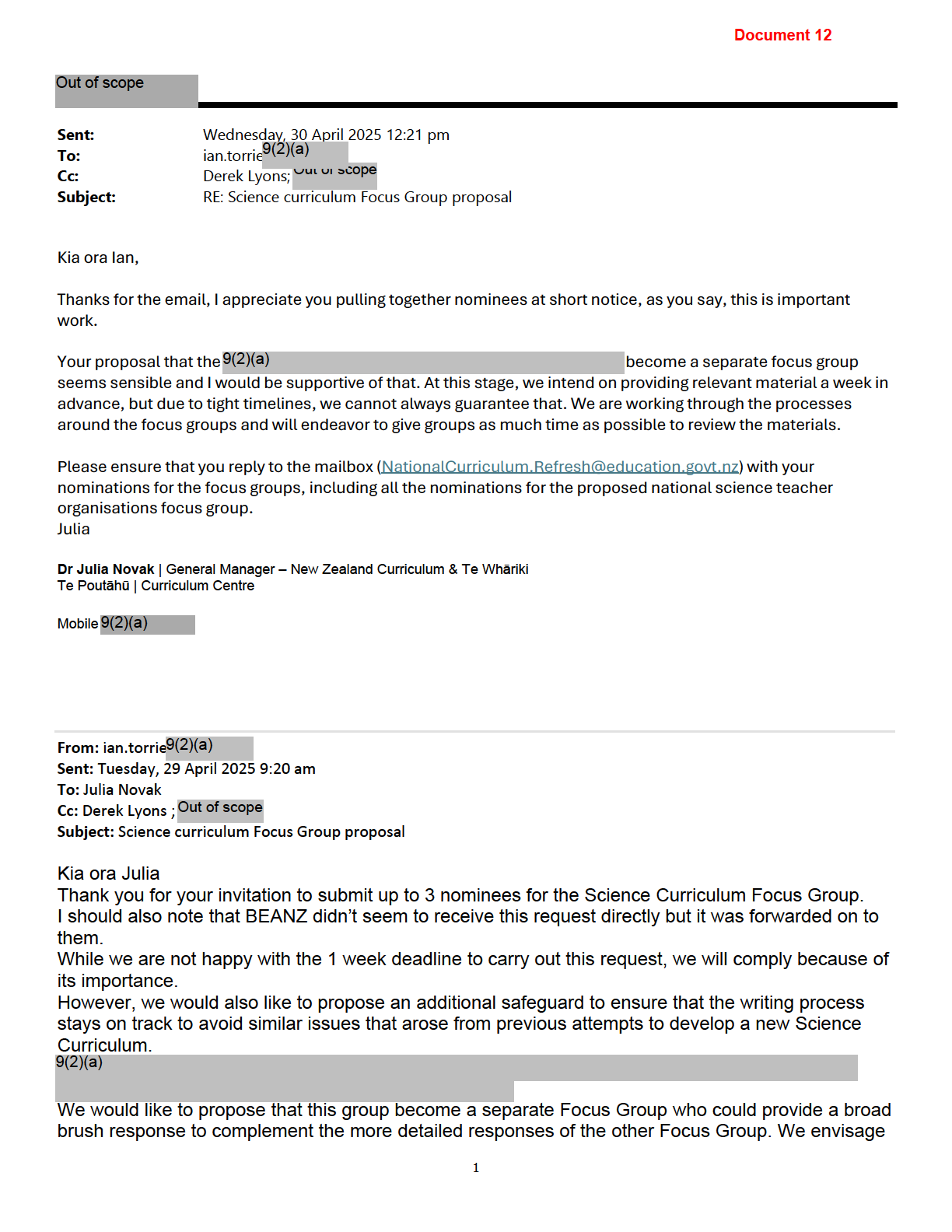
that the Ministry would provide the NSTO members with any material that requires feedback, one
week before our regular meetings and then a Ministry official could attend the start of our meeting to
receive any group feedback. We would not disseminate or discuss any details of the material
provided for these meetings beyond 9(2)(a)
.
Could you please respond to this suggestion by 5pm on Wed 30th April as the nominations we select
for the other Focus Group would be impacted by this decision.
Thak you for your consideration
9(2)(a)
NZASE, BEANZ, SCENZ, NZIP, HATA and ESSENZ.
1982
ACT
INFORMATION
OFFICIAL
THE
UNDER
RELEASED
2
1982
ACT
INFORMATION
OFFICIAL
THE
UNDER
RELEASED

NCEA Review Team
National Office 1 The Terrace
education.govt.nz
He mea tārai e mātou te mātauranga kia rangatira ai, kia mana taurite ai ōna huanga
We shape an education system that delivers equitable and excellent outcomes
From: [email address] <[email address]>
1982
Sent: Friday, 21 March 2025 3:40 pm
To: NCEA Review <[email address]>
Subject: FW: NCEA Review and Maintenance Program for 2025
ACT
You don't often get email from [email address]. Learn why this is important
Hi
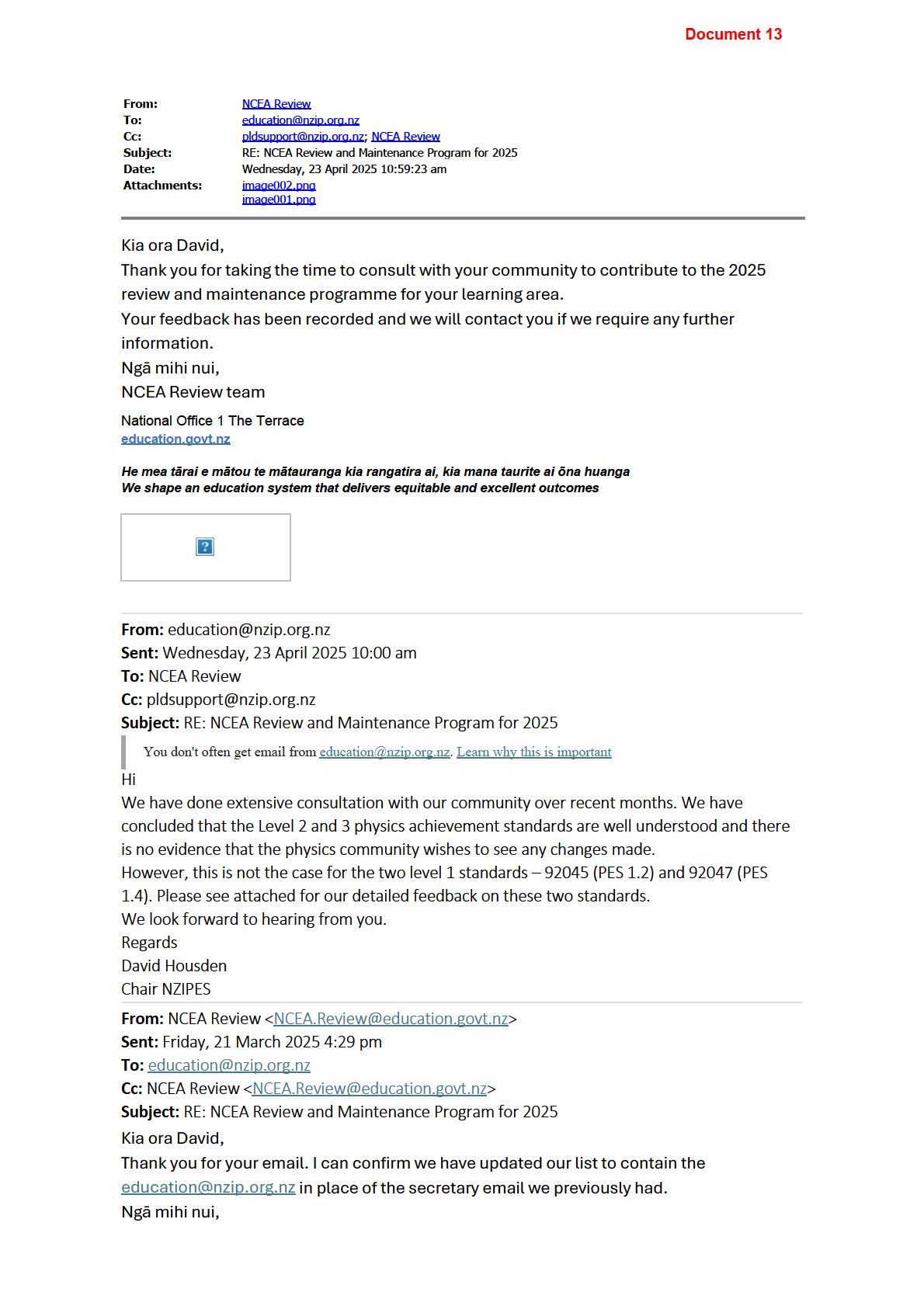
First can I ask you to change the contact details you are using for NZIP. The Education Section of
NZIP is the correct address as stated in all correspondence for years with the MoE.
The correct address is this one – [email address]
Cam you please confirm the change of details and then we will consider our response.
Thanks
David Housden
INFORMATION
Chair NZIPES
From: 9(2)(a)
<[email address]>
Sent: Friday, 21 March 2025 3:06 pm
From: NCEA Review <[email address]
OFFICIAL >
Date: Thursday, 20 March 2025 at 2:29 PM
Subject: NCEA Review and Maintenance Program for 2025
THE
Kia ora,
We are inviting Subject Associations and their memberships to provide input into the NCEA
Review and Maintenance Program (RAMP) for 2025.
The annual RAMP work programme aims to strengthen assessment materials across the
UNDER
three levels of NCEA. Most RAMP updates are made to improve clarity and interpretation.
Your input into this process is particularly valued, because your membership is made up of
classroom teachers who work with NCEA materials first hand.
In your response to this email please let us know:
any specific feedback from your membership towards strengthening NCEA
materials in your subject area
RELEASED
any suggested solutions that your membership has already discussed
any specific points relating to authenticity considerations in your subject area.
This includes any particular concerns with student use of generative AI in
assessment.
We ask for you to respond by April 24th so we can collate input from all contributors and
begin RAMP work in May. After that point there may be a need for further contact with you
to clarify your input and collaborate on the work involved.

Ngā mihi,
The NCEA Review Team
National Office 1 The Terrace
education.govt.nz
He mea tārai e mātou te mātauranga kia rangatira ai, kia mana taurite ai ōna huanga
We shape an education system that delivers equitable and excellent outcomes
1982
DISCLAIMER:
ACT
This email and any attachments may contain information that is confidential and subject to legal privilege. If you are not the
intended recipient, any use, dissemination, distribution or duplication of this email and attachments is prohibited. If you have
received this email in error please notify the author immediately and erase all copies of the email and attachments. The Ministry
of Education accepts no responsibility for changes made to this message or attachments after transmission from the Ministry.
DISCLAIMER:
This email and any attachments may contain information that is confidential and subject to legal privilege. If you are not the
intended recipient, any use, dissemination, distribution or duplication of this email and attachments is prohibited. If you have
received this email in error please notify the author immediately and erase all copies of the email and attachments. The Ministry
INFORMATION
of Education accepts no responsibility for changes made to this message or attachments after transmission from the Ministry.
OFFICIAL
THE
UNDER
RELEASED
1982
ACT
INFORMATION
OFFICIAL
THE
UNDER
RELEASED

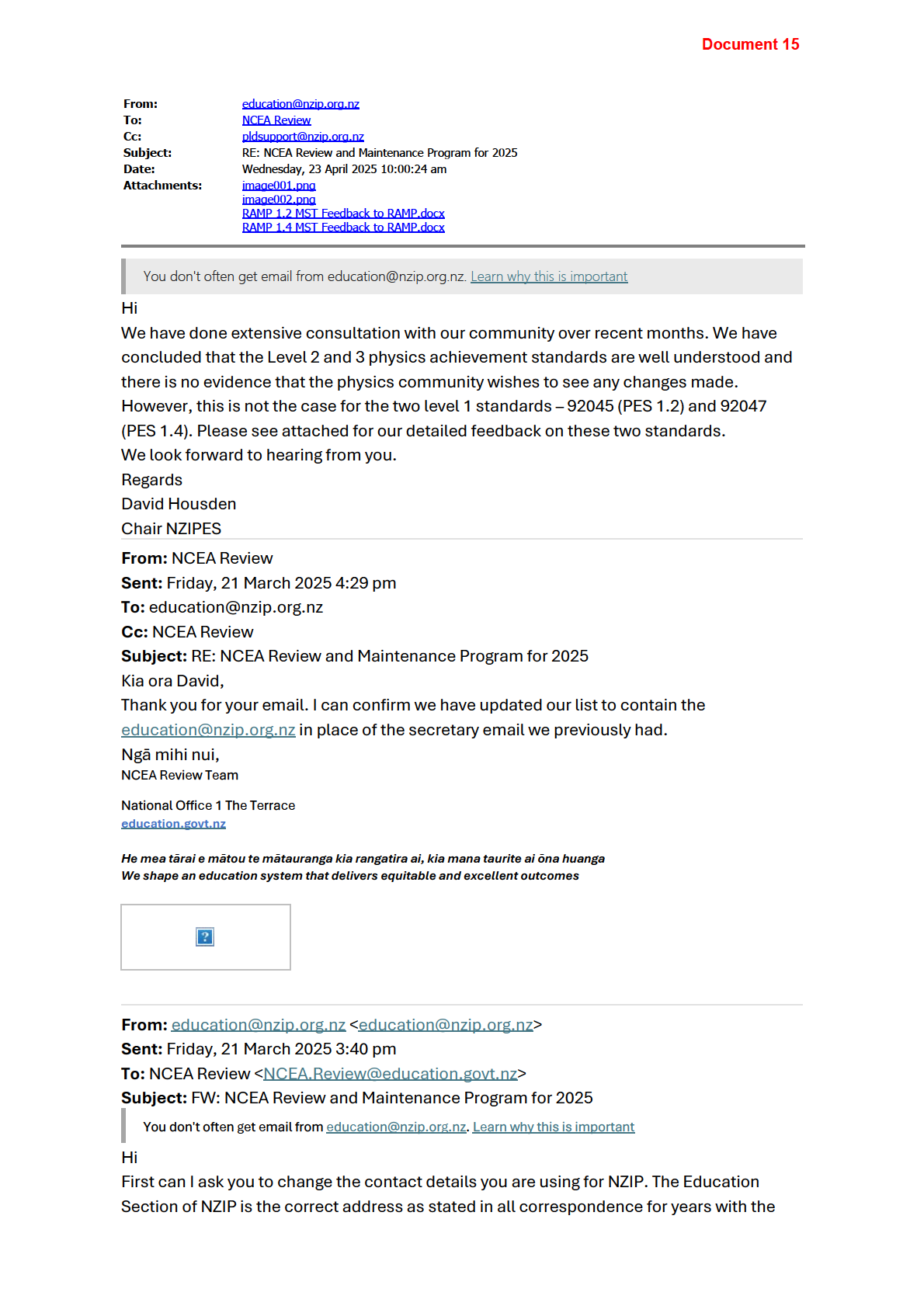
MoE.
The correct address is this one – [email address]
Cam you please confirm the change of details and then we will consider our response.
Thanks
David Housden
Chair NZIPES
From: 9(2)(a)
<[email address]>
Sent: Friday, 21 March 2025 3:06 pm
From: NCEA Review <[email address]>
1982
Date: Thursday, 20 March 2025 at 2:29 PM
Subject: NCEA Review and Maintenance Program for 2025
Kia ora,
ACT
We are inviting Subject Associations and their memberships to provide input into the NCEA
Review and Maintenance Program (RAMP) for 2025.
The annual RAMP work programme aims to strengthen assessment materials across the
three levels of NCEA. Most RAMP updates are made to improve clarity and interpretation.
Your input into this process is particularly valued, because your membership is made up of
classroom teachers who work with NCEA materials first hand.
In your response to this email please let us know:
INFORMATION
any specific feedback from your membership towards strengthening NCEA
materials in your subject area
any suggested solutions that your membership has already discussed
any specific points relating to authenticity considerations in your subject area.
This includes any particular concerns with student use of generative AI in
assessment.
OFFICIAL
We ask for you to respond by April 24th so we can collate input from all contributors and
begin RAMP work in May. After that point there may be a need for further contact with you
THE
to clarify your input and collaborate on the work involved.
Ngā mihi,
The NCEA Review Team
UNDER
National Office 1 The Terrace
education.govt.nz
He mea tārai e mātou te mātauranga kia rangatira ai, kia mana taurite ai ōna huanga We shape an education system that delivers equitable and excellent outcomes
RELEASED
DISCLAIMER:
This email and any attachments may contain information that is confidential and subject to legal privilege. If you are not the
intended recipient, any use, dissemination, distribution or duplication of this email and attachments is prohibited. If you have
received this email in error please notify the author immediately and erase all copies of the email and attachments. The Ministry
of Education accepts no responsibility for changes made to this message or attachments after transmission from the Ministry.
DISCLAIMER:
This email and any attachments may contain information that is confidential and subject to legal privilege. If you are not the
intended recipient, any use, dissemination, distribution or duplication of this email and attachments is prohibited. If you have
received this email in error please notify the author immediately and erase all copies of the email and attachments. The Ministry
of Education accepts no responsibility for changes made to this message or attachments after transmission from the Ministry.
1982
ACT
INFORMATION
OFFICIAL
THE
UNDER
RELEASED
Document 15A
RAMP: PESS 1.2 Investigation (92045) (Internal):
Achievement
Achievement with Merit
Achievement with
Excellence
• Demonstrate
• Explain a physical
• Analyse a physical
understanding of a physical
phenomenon through
phenomenon through
phenomenon through
investigation
investigation
investigation
The Conditions of Assessment:
1982
Assessor involvement during the assessment event is limited to:
•
providing general feedback. They can suggest sections of student work that would benefit from
ACT
further development, or skills a student may need to revisit across the work. Student work that has
received sustained or detailed feedback is not suitable for submission towards this Achievement
Standard.
•
providing advice when students select relevant information recorded as observations or providing
students with comparative data.
We suspect that the CoA are trying to helpfully point out that “general feedback” can be used to direct
students to collect meaningful data of the right sort and at the right amount (removing the issue of
INFORMATION
whether the students have collected sufficient data by the expectation that this will be managed at a
classroom level), but it needs
more direct instructions to teachers that they can guide students to
collecting appropriate data.
Since the current standard asks students to demonstrate understanding of a physical phenomenon
through investigation, it does not directly assess the investigation. This is quite different from the previous
OFFICIAL
standard and science teachers are not necessarily comfortable with this and may struggle to engage with
all groups of students as part of the practical portion of the assessment.
THE
UNDER
RELEASED
The explanatory notes need updating or improving.
Explanatory Note 1
Demonstrate understanding of a
The plural nature of concept
s and relationship
s makes the
physical phenomenon through
standard quite challenging and considerably more difficult than
investigation involves:
its previous version.
•
describing relevant
This is both for the students providing the evidence and for the
physics concepts
teachers providing suitable tasks to allow the students to
provide the evidence.
•
describing relationships
involved in a physical
Equally, how relevant to the phenomenon must the physics
phenomenon, using
concepts be?
1982
evidence.
Explain a physical phenomenon
It is not immediately obvious that the step up to Merit regards
ACT
through investigation involves:
explaining how the concepts relate to the phenomenon (and not
•
explaining how physics
explaining the concepts and relationships) and explaining how
concepts relate to the
the relationships are involved in the phenomenon.
physical phenomenon
The evidence required for explaining how physics concepts
•
explaining how
relate is relatively well explained in the exemplars but
relationships are involved “
unpacked relevant formulae linked to this context, and
in the physical
provided appropriate calculation, tabling, or graphing that
phenomenon, using
supports their explanation of each relationship and how they
processed evidence.
are involved” provides no useful example of the
INFORMATION
evidence
required for explaining the relationships.
Analyse a physical phenomenon
The step up from Merit to Excellence is not well explained by
through investigation involves:
EN1 (nor in the exemplars). Better wording is required than
•
integrating processed
“integrating processed information” and better examples to
evidence with a
allow teachers to differentiate based upon student evidence.
OFFICIAL
discussion of relevant
physics concepts and
relationships involved.
THE
UNDER
RELEASED
Explanatory Note 2
Evidence must be gathered
Evidence collected through investigation is a very important
through investigation. Evidence
part of science. However, not only must students collect
must include numerical data and
evidence, but they must collect useful, relatively perfect,
may include observations.
evidence to be able to link it to concepts and relationships.
Previously, students gained credit for realising that their
collected evidence was flawed. Now the assessor really must
ensure that results are reliable/useful. We suspect that there
will be a number of assessors providing comparative data
simply to give students “reliable” evidence that they can use
.
Processed evidence is evidence
There are two step-ups in this standard. Processing evidence
1982
that has been synthesised by the
and explaining how relationships are involved in the physical
student to provide more
phenomenon. This is clear in the exemplars but not so clear in
meaningful information.
the wording of EN2.
ACT
Examples of processed evidence
The examples of processed evidence require clearer
include:
requirements for evidence e.g.
•
calculations
• calculations of averages or speed from distance and time
•
tables
• tabulating data into a correctly headed ordered table
•
graphs.
• referring to the trendline on a correctly plotted graph
(which includes labelling of variables and appropriate
units).
INFORMATION
OFFICIAL
THE
UNDER
RELEASED
Explanatory Note 3
A
physical phenomenon refers to
The definition of a physical phenomenon requires greater
an observable event or process
clarification for Year 11 students and probably better examples.
that involves physics concepts.
Dispersion in a prism is a physical phenomenon but would be
Examples of a physical
very difficult to investigate as part of this Achievement
phenomenon include:
standard. Measuring dispersion (angles) is appropriate but
colour is not numerical, nor is refractive index, so this makes
• dispersion in a prism
the use of this phenomenon difficult.
• a falling object
The brightness of a light bulb is a physical phenomenon directly
• the brightness of a light
related to its power output, which in turn depends on the
bulb.
current flowing through its filament and the resistance of the
1982
filament. More specifically, the power (P) of a light bulb is
calculated as P = I²R, where I is the current and R is the
resistance. A higher current and/or higher resistance lead to a
ACT
brighter bulb, as the filament heats up more and emits more
light. Measuring current is appropriate but measuring the
brightness of a light bulb is difficult particularly with the ban on
student cell phones. Schools do not have class sets of
luxmeters.
Better examples should be provided.
INFORMATION
OFFICIAL
THE
UNDER
RELEASED
Explanatory Note 4
Physics concepts refer to ideas
It would be helpful if these concepts were in the same order i.e.
and knowledge related to physics. dispersion in a prism/refraction, a falling object/acceleration,
Examples of physics concepts
the brightness of a light bulb/power but – much more
include:
importantly – each phenomenon should be linked to at least
two concepts e.g. a falling object/acceleration and terminal
• power
velocity (to remind assessors of the plural nature of the
• refraction
evidence requirements)
• acceleration.
Explanatory Note 5
1982
A
relationship in physics is a
There are no examples in the assessment schedule exemplars
connection between physical
of actual relationships (in sentences or in formula) that connect
ACT
quantities that can be observed.
observable physical quantities. Assessors need a better
understanding of the evidence requirements when assessing
the relationship aspect of the standard
The Activity exemplars need updating or improving.
The Exemplar material needs updating or improving. The exemplars relate more to the old standard 90935
v3 than the new standard 92046 v3 with all of the planning, discussion of variables, control variables, and
INFORMATION
critiquing of the experiment (particularly the Merit and Excellence exemplars).
In all three exemplars, there does not appear to be two concepts and explanations of how two
relationships are involved in the physical phenomenon, using processed evidence.
The Achieved exemplar does have evidence of two relationships (based on the graph) but the Merit
exemplar has evidence of only one relationship using evidence (and an inability to plot a correct bar graph)
OFFICIAL
and the Excellence exemplar attempts two relationships but the argument that jumping from a higher
height means a higher average velocity is tenuous. It could be a second relationship based upon data.
THE
Currently, it would appear that schools are retaining the same level of student performance by use of
common sense as opposed to listening to moderation feedback.
UNDER
RELEASED
Document 15B
RAMP: PESS 1.4 Energy (92047) (External):
Achievement
Achievement with Merit
Achievement with
Excellence
Demonstrate understanding of a
Explain a physical system
Analyse a physical system
physical system using energy
using energy concepts
using energy concepts
concepts
The explanatory notes need updating or improving.
1982
Explanatory Note 1
Demonstrate understanding of a
Explanatory Note seems reasonable.
ACT
physical system using energy
concepts involves:
•
describing a physical
system
•
describing change to the
physical system, using
evidence
•
describing relevant energy
INFORMATION
concepts, using evidence.
Explain a physical system using
energy concepts involves:
•
explaining change to the
physical system, using
OFFICIAL
relevant energy concepts
and evidence.
THE
Analyse a physical system using
energy concepts involves:
•
examining implications of
UNDER
the change to the
physical system, using
relevant energy concepts
and evidence.
RELEASED
Page 1 of 4
2025 Assessment Specifications – Level 1 Physics, Earth and Space Science
Explanatory Note 2
A physical system refers to a
Explanatory Note seems reasonable except that Examples of
defined space with either an object physical properties or behaviour include surely should read:
or interacting objects.
•
the motion of a falling object
Examples of a physical system
•
the resistance of a wire (please note comment later)
include:
•
the temperature of an object
•
vacuum flask
•
insulated home
•
simple electrical circuits
1982
•
falling objects
•
lifting of objects.
ACT
For the purpose of this
achievement standard, a physical
system can be described in terms
of its physical properties or
behaviour that relate to energy
concepts.
Examples of physical properties or
behaviour include:
INFORMATION
•
the height of a falling object
•
motion
•
the resistance of a wire
•
the temperature of an object.
Change to a physical system is any
OFFICIAL
change to the physical properties
or behaviour of the system.
THE
UNDER
RELEASED
Page 2 of 4
2025 Assessment Specifications – Level 1 Physics, Earth and Space Science
Explanatory Note 3
For the purpose of this
Explaining physical systems using energy and energy concepts
achievement standard,
energy
is not a new idea to Level 1 Sciences.
concepts are ideas and principles
The context of energy involving potential energy, kinetic energy,
related to energy that are used to
work done, power is familiar to teachers.
understand change in physical
systems.
The context of energy involving changing state, transfer of
thermal energy, thermal energy and power is familiar to
Examples of energy concepts
teachers.
include:
However, the use of resistance, electrical power, Ohm’s law
•
energy transfer
(V=IR), and their relation to the context of energy is not so
1982
•
conservation of energy
familiar.
•
forms of energy
At high school level the following is a common treatment of the
(mechanical, thermal,
ideas: Resistance causes electrical energy to be converted into
ACT
electrical).
thermal energy (heat). This is because resistance acts as a
Associated formulae include:
hindrance to the flow of electrical current, similar to friction
hindering the movement of an object. When current encounters
•
ΔE = Pt
resistance, it dissipates energy as heat.
•
Ek = ½ mv2
To use P = VI and V = IR to explain and analyse a physical
•
Ep = mgΔh
system using energy concepts requires additional ideas and/or
concepts that are not described in EN2.
•
W= Fd
These ideas such as relating energy dissipated to relative size
INFORMATION
of
•
E (thermal) = mcΔT
resistance in a series or parallel circuits are conceptually more
•
E (thermal) = mL
difficult than the mechanical or heat equivalent concepts.
•
P = VI
EN2 needs more detail regarding the expected outcomes of the
electrical context or the examination will contain unanticipated
•
V = IR
ideas or principles (such as in 2024). NZIPES suggest the
OFFICIAL
removal of V=IR and the reference in EN2 to resistance. There is
a serious risk that future examinations focus on the ideas
associated with resistance and the construction of circuits
THE
whereas this standard should only focus on the ideas of energy
in the context of simple electrical circuits.
UNDER
RELEASED
Page 3 of 4
2025 Assessment Specifications – Level 1 Physics, Earth and Space Science
Explanatory Note 4
Evidence may include written
It would be helpful if these concepts were in the same order i.e.
accounts, representations, or
dispersion in a prism/refraction, a falling object/acceleration,
calculations.
the brightness of a light bulb/power but – much more
importantly – each phenomenon should be linked to at least
two concepts e.g. a falling object/acceleration and terminal
velocity (to remind assessors of the plural nature of the
evidence requirements)
1982
Assessment Specifications
ACT
Standard:
92047
Title:
Demonstrate understanding of a physical system using energy
concepts
Version:
3
Number of credits:
5
Assessment medium:
Printed paper
INFORMATION
Candidates will be required to demonstrate their understanding of energy in a physical system
linked to energy concepts involved, and the implications for energy concepts.
There will be three questions with a focus on mechanical energy, thermal energy, and electrical energy.
Responses will need to be descriptive and be supported by representation, annotated diagrams,
OFFICIAL
graphs, and calculations.
The examination paper will contain all necessary mathematical formulae (see Explanatory Note
THE
3 of AS92047)
UNDER
RELEASED
Page 4 of 4
2025 Assessment Specifications – Level 1 Physics, Earth and Space Science
Document 17
From:
National Curriculum Refresh
To:
National Curriculum Refresh
Bcc:
9(2)(a)
Subject:
Developing the New Zealand Curriculum – Update for Contributor Groups
Date:
Tuesday, 15 April 2025 3:53:51 pm
Attachments:
image001.png
Tēnā koutou
1982
Following my email on 4 April, I am pleased to provide an update on the engagement
expectations of the Contributor Groups for the next phase of the New Zealand Curriculum
ACT
Refresh, along with timeframes.
Engagement expectations
As a member of the Contributor Groups, we thank you and acknowledge your subject matter
input. Your expertise is integral to the development of a refreshed curriculum that is knowledge-
rich and grounded in the science of learning.
The knowledge-rich curriculum we are developing is different to the current curriculum. The new
curriculum will include a clear scope and sequence for each Learning Area, documenting what
knowledge and skills students need to learn - and in what order - to develop understanding in
each subject over time.
INFORMATION
As you have experienced already, developing a knowledge-rich curriculum requires a new way of
thinking and approach, and it is critical that our ways of working reflect this. We need to be clear
about what students need to understand, know, and do in each year from Years 0 to 13 and
provide evidence-based teaching practices for teachers and kaiako to use. We realise this is quite
different and appreciate your help with this.
OFFICIAL
As members of the Contributor Groups, we are seeking your expertise with the focus of a
knowledge-rich lens that aligns to a sequenced approach to learning.
Timeframes
THE
We are currently working through the lessons learned from English Years 7-13, which will inform
our approach to how we present “Understand, Know, Do” in other Learning Areas. Once this has
been completed, we will communicate any changes and the rationale for these, as there
may be some changes required to the knowledge phase that is in development.
UNDER
We are on track to have the detailed knowledge phase completed in June. The timeline for this
will be updated to include the change in combining knowledge and progression and will be
shared in the coming weeks.
Throughout the next phase, the work you contribute to will continue to be reviewed by internal
and external reviewers. This means that the Ministry, as owners of the content, may make
further changes to the content as required.
If you have any questions or would like to discuss anything further, please reply to us at:
RELEASED
[email address]
Ngā mihi
Derek Lyons
Programme Director
The New Zealand Curriculum Refresh Team
Te Poutāhū (Curriculum Centre)
National Office 1 The Terrace
education.govt.nz

1982
ACT
INFORMATION
OFFICIAL
THE
UNDER
RELEASED
 Document 20
Out of scope
Sent:
Tuesday, 1 April 2025 10:31 am
To:
Doug Walker
Subject:
RE: Science SAs and MoE - Curriculum update
Hi Doug
Probably not the type of update you want. I am currently tasked with being one of the internal
independent reviewers. The result of which is the writing team and the program as a whole
1982
keeps me at arm’s length to help
ACT
Evan Sutherland | Lead Adviser, Science
Te Poutāhū (Curriculum Centre)
DDI +6444396436 | Mobile
National Office 1 The Terrace
education.govt.nz
He mea tārai e mātou te mātauranga kia rangatira ai, kia mana taurite ai ōna huanga We shape an education system that delivers equitable and excellent outcomes
INFORMATION
OFFICIAL
From: Doug Walker
Sent: Tuesday, 1 April 2025 10:00 am
THE
To: Julia Novak
Cc: Derek Lyons ; Evan Sutherland
Subject: Re: Science SAs and MoE - Curriculum update
Thanks for the heads-up. Best wishes for your meeting.
UNDER
Derek or Evan, will you be able to provide an update?
On Mon, 31 Mar 2025 at 18:12, Julia Novak <[email address]> wrote:
Kia ora Doug,
RELEASED
Please accept my apologies for the meeting this week. I am in a meeting with the Minister, which has now just
been re-arranged for 4.30-6 tomorrow.
1
Julia
-----Original Appointment-----
From: Doug Walker <[email address]>
Sent: Tuesday, 25 March 2025 9:55 pm
To: Doug Walker; Derek Lyons; dhousden9(2)(a)
; Evan Sutherland; 9(2)(a)
Julia Novak;
9(2)(a)
; 9(2)(a)
Kenneth Loh; 9(2)(a)
; 9(2)(a)
; [email address]
Subject: Science SAs and MoE - Curriculum update
When: Tuesday, 1 April 2025 5:00 pm-6:00 pm Pacific/Auckland.
9(2)(k)
1982
ACT
ht ps us06web zoom us j 82946055548 pwd= Rlv ff2c bO C3 Q wabEHdef0bTA
9(2)(k)
INFORMATION
OFFICIAL
THE
UNDER
RELEASED
2
9(2)(k)
1982
ACT
INFORMATION
OFFICIAL
Guests
THE
Doug Walker- organiser
[email address]
UNDER
dhousden9(2)(a)
[email address]
ian.torrie9(2)(a)
RELEASED
[email address]
9(2)(a)
3
9(2)(a)
[email address]
9(2)(a)
9(2)(a)
[email address]
1982
View all guest info
ACT
Reply for [email address]
Maybe
No
Yes
More options
INFORMATION
Invitation from Google Calendar
OFFICIAL
You are receiving this email because you are an attendee of the event.
THE
Forwarding this invitation could allow any recipient to send a response to the organiser, be added to the guest list, invite
others regardless of their own invitation status or modify your RSVP. Learn more
UNDER
DISCLAIMER:
This email and any attachments may contain information that is confidential and subject to legal privilege. If you are not the intended recipient, any use,
dissemination, distribution or duplication of this email and attachments is prohibited. If you have received this email in error please notify the author
immediately and erase all copies of the email and attachments. The Ministry of Education accepts no responsibility for changes made to this message or
attachments after transmission from the Ministry.
RELEASED
4
